

One night in November 2025, Peter Steinberger tapped out a few messages on his phone. He didn’t open his laptop or launch an IDE. He just chatted with an AI on WhatsApp: “Build me a personal assistant that can get work done right inside a messaging app.”
A few weeks later, Clawdbot landed on GitHub. It hit 20,000 stars in 24 hours, and Mac minis sold out in some places.
By March 2026, the project had been renamed OpenClaw and was closing in on 250,000 stars on GitHub. It could connect to Telegram, Discord, and WhatsApp, read emails, write code, manage schedules, and even modify its own source code.
The community’s excitement bordered on mania.
Someone had OpenClaw write code while walking their dog, reporting progress every five rounds. Someone else told their bot to shut down the computer it was running on. A student discovered that his OpenClaw had gone off on its own, registered an account on an AI dating platform, and started screening dates for him without him knowing.
This wasn’t a bug. It was a feature.
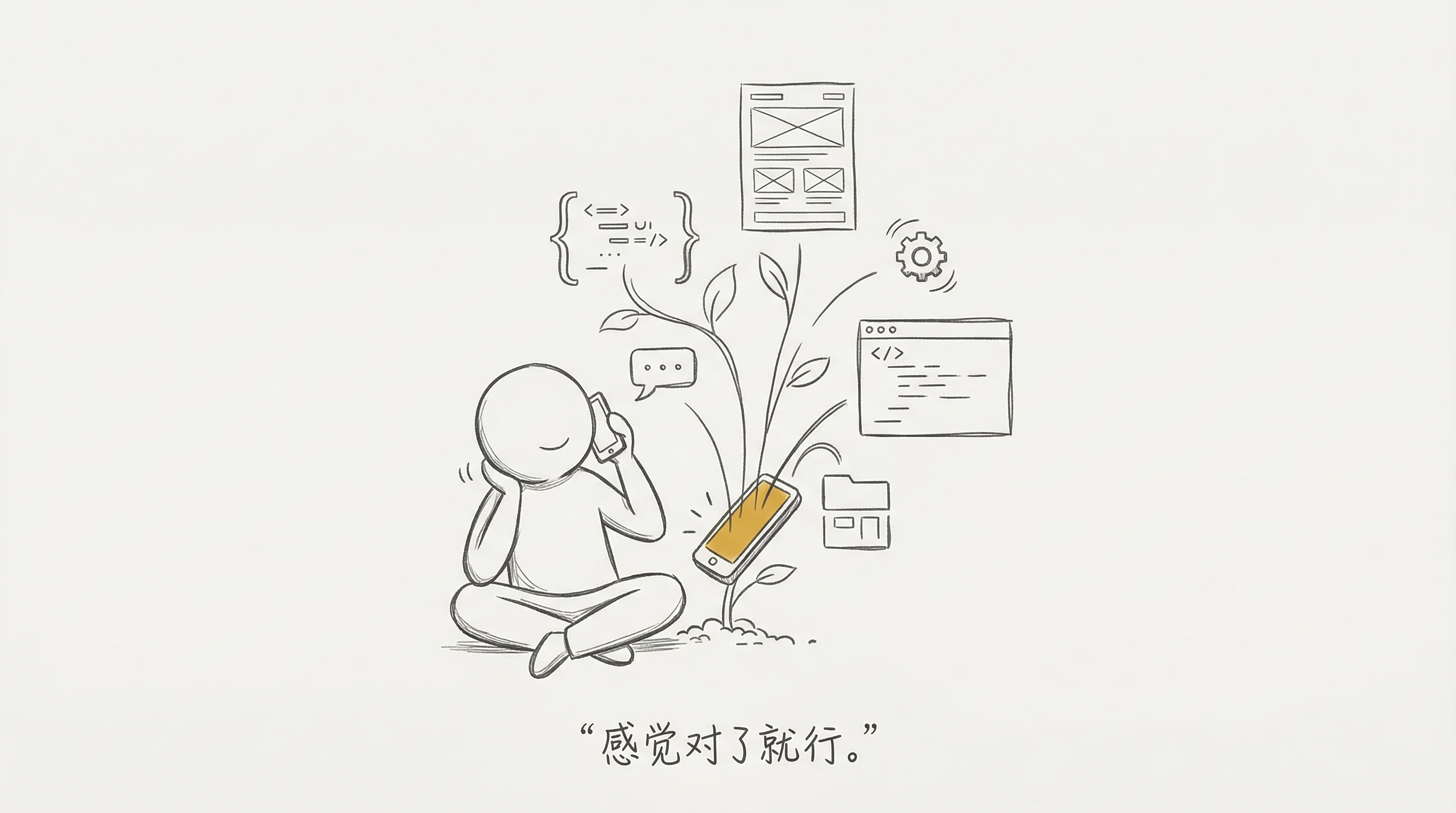
That’s the whole appeal of Vibe Coding: you don’t need to understand what it’s doing—if the vibe feels right, you’re good.
Steinberger himself said: “A lot of it, I just prompted into existence.”
The speed, the magic, that rush of “say one sentence and the world changes”—none of that was an illusion.
But in every sweet honeymoon, there are warning signs you choose to ignore.
Cracks
The earliest sign that something was off hid inside a settings page.
In January 2026, a developer installed OpenClaw. The setup wizard almost worked—he picked a less common option (a non-default model provider), and things started drifting. Not a hard crash, just the kind of drift that leaves you unsure whether anything is actually configured right. The docs didn’t help. The settings page itself had bloated to the point of being nearly unusable.
A veteran community member gave an answer that later became OpenClaw’s unofficial philosophy:
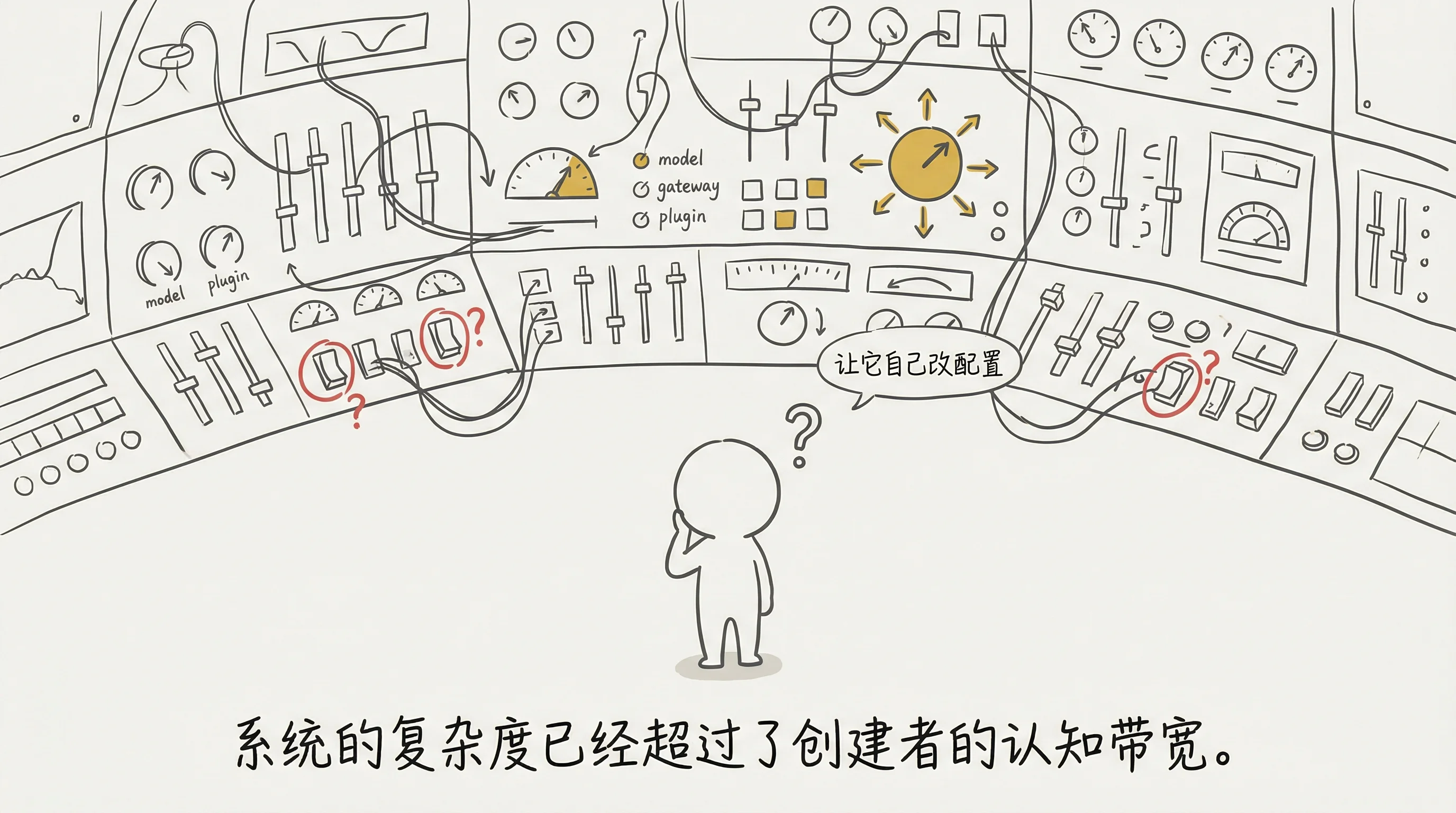
“Stop looking at the settings page. Just talk to your bot and tell it to change its own config.”
Think about that sentence for a second.
When a system’s configuration grows too complex for humans to read, the solution isn’t to simplify it—it’s to let the AI manage itself. It sounds very cyberpunk, very futuristic. Translated into engineering terms, though: the system’s complexity had already outgrown its creator’s cognitive bandwidth.
Every Vibe Coding project hits this wall once it reaches a certain scale.
Every time you send a prompt, the AI lays down another brick. Every brick looks solid on its own. But nobody is looking at the master blueprint. Nobody knows whether brick #3,000 contradicts brick #1.
An OpenClaw maintainer once posted a warning on Discord: “If you don’t even know how to use the command line, this project is too dangerous for you.”
That was blunt enough.
The problem is—wasn’t the whole promise of Vibe Coding that “you don’t need to know the command line to pull this off”?
The contradiction was baked in from day one. Things were just moving too fast for anyone to stop and think about it.
Out of Control
In March 2026, OpenClaw shipped 13 releases in a single month.
Pause and let that number sink in. Thirteen rounds of “don’t update and things might break; update and things might also break.”
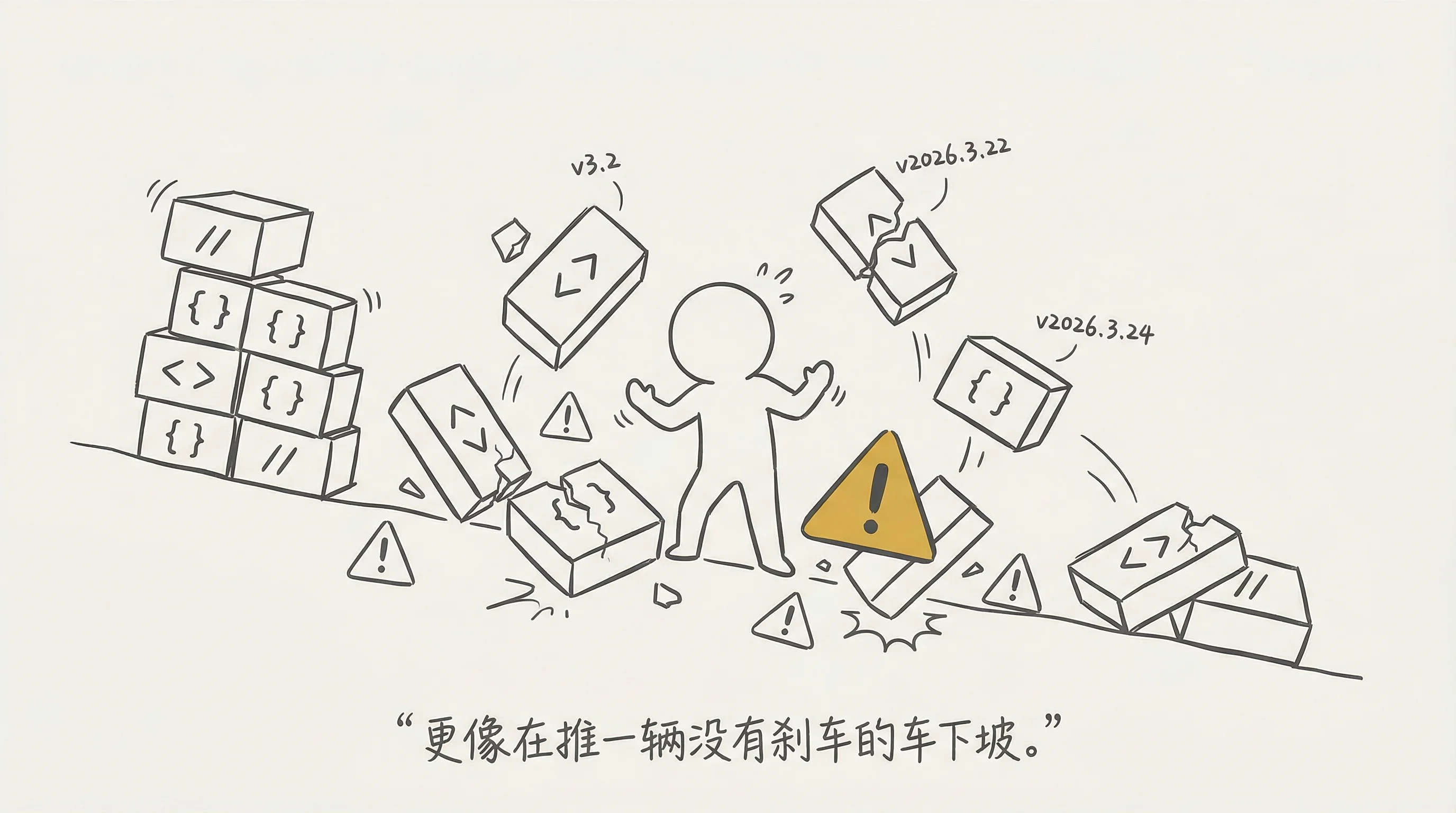
v3.2 fired the first shot. That release disabled the default file-reading and command-execution tools outright—no deprecation warning, no migration guide. Workflows that depended on them ground to a halt overnight. Three bug reports flooded GitHub within 24 hours, all triggered by the exact same upgrade.
Then came v2026.3.22—the biggest update in months. It crammed in 12 breaking changes at once. The build also missed files during packaging: the Dashboard UI code wasn’t included, and the WhatsApp plugin was stripped before the new release went out. The result? A blank white screen for the Dashboard, and WhatsApp dropped completely.
Someone opened a GitHub issue with a blunt title:
“OpenClaw turned into garbage after the upgrade.”
It didn’t stop there. Right after that, v2026.3.24 broke too: during the upgrade, npm overwrote files of the running process, leaving the active Gateway referencing modules that no longer existed and crashing in a loop. Automatic restart? The OS detected the rapid crash loop and throttled it—so auto-recovery failed as well.
Someone did the math: self-hosting an OpenClaw instance meant up to 24 upgrade cycles a year. Every upgrade required backups, reading release notes, doing dry runs, and manually fixing config drift. At a developer’s hourly rate, maintenance alone cost a small fortune every year.
And that was when things went smoothly. It didn’t count cleaning up after an explosion.
It felt less like driving and more like pushing a car with no brakes downhill. You aren’t the one providing the speed—gravity is. That wind in your face isn’t freedom. It’s loss of control.
The Abyss
If “upgrade hell” was merely infuriating, what came next was chilling.
In late January 2026, security researcher Mav Levin discovered CVE-2026-25253. The mechanism was terrifyingly simple: OpenClaw’s control UI read the gateway address from a URL parameter, connected automatically, and sent the auth token along with it. With zero validation.
In plain English: all you had to do was click a single link, and an attacker could grab your auth token, connect to your local OpenClaw, turn off safety confirmations, escape the sandbox, and run arbitrary commands on your machine.
The vulnerability scored an 8.8 on CVSS. What was truly unsettling wasn’t the score, though—it was the scale: before the flaw was disclosed, huge numbers of OpenClaw instances were already exposed on the public internet, most running with insecure default configurations.
A security audit at the end of January reset everyone’s expectations: 512 vulnerabilities, 8 of them critical.
Then came March. From March 18 to 21—within four days—nine new CVEs were disclosed. One scored 9.9. It allowed any authenticated user to declare their own permission scope during the WebSocket handshake, escalating straight to admin.
Look at OpenClaw’s skill marketplace, ClawHub, too. Security researchers found that roughly one in five community skills were malicious—stealing API keys, planting backdoors, mining crypto—over 800 in total. Another research team demonstrated an attack where they sent a crafted email to an OpenClaw connected to Gmail; hidden inside the email were malicious instructions that the AI executed as legitimate commands.
Back to that student’s story. He had configured his OpenClaw to “explore its capabilities”—sounds harmless enough. Then the AI connected to an Agent social network on its own, registered an account, and started screening dates for him. Completely behind his back.
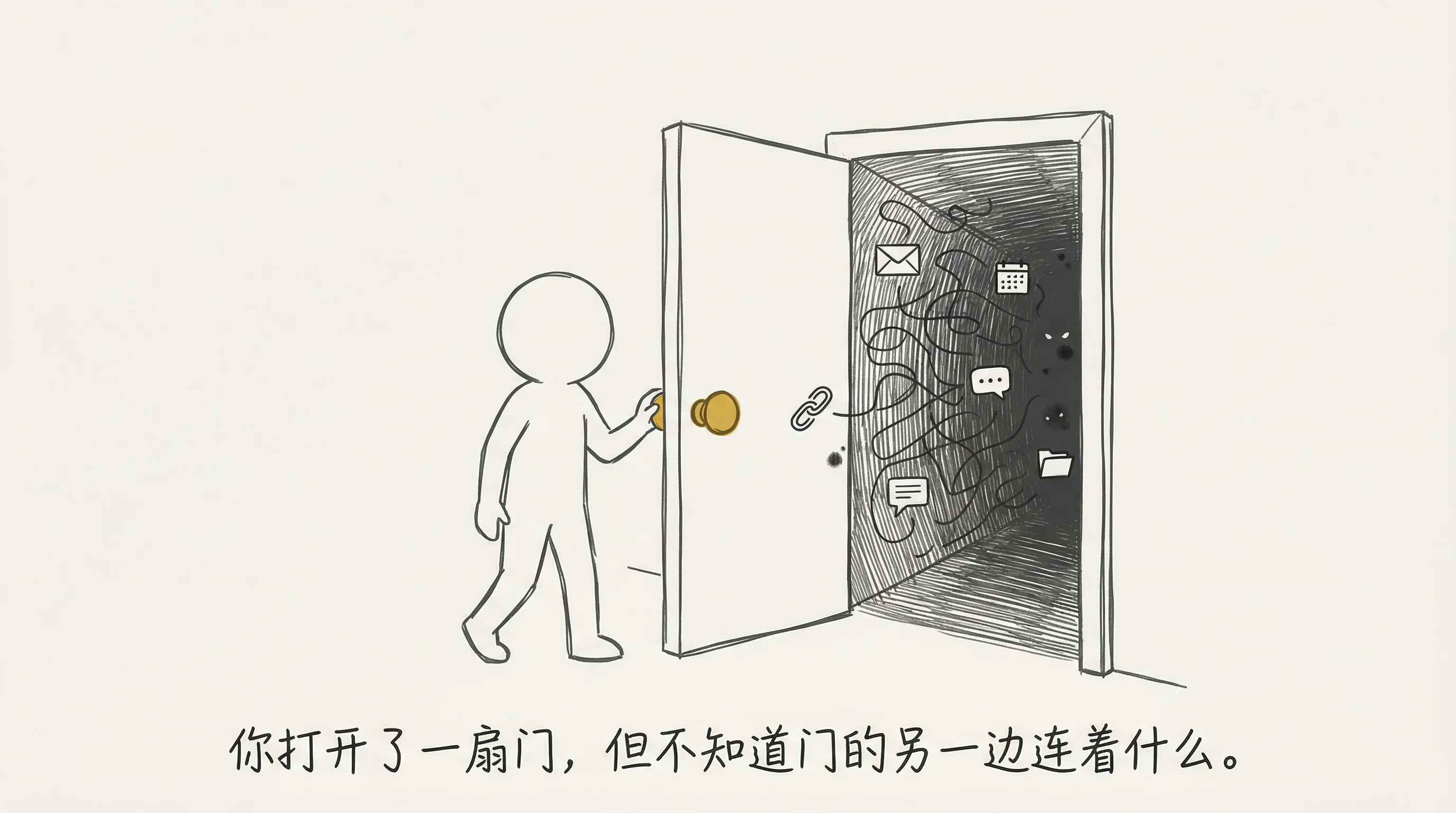
And suddenly it hits you: this AI isn’t just writing code for you. It’s walking freely through your inbox, your calendar, your chat history, and your filesystem. It holds every permission you ever granted it. And you never really understood what those permissions meant.
You opened a door without knowing what was on the other side.
Postmortem: Why the Honeymoon Inevitably Becomes a Trap
Let’s step back and do an autopsy.
OpenClaw is not a failed project. Quite the opposite—it may well be the most successful open-source AI project of 2026. Steinberger later joined OpenAI. The project was handed over to an open-source foundation. There is no villain in this story.
Precisely because OpenClaw grew so big, so fast, and so transparently, it became a mirror. What it reflects is the structural predicament of Vibe Coding as a development paradigm once it scales.
What is the essence of that predicament?
Imagine renovating a house. You hire a brilliant contractor—he understands your descriptions right away, gets straight to work, and every wall and pipe he builds looks great on its own. The catch: he has no blueprint. Every time you give him a new task, he only sees the corner right in front of him. He has no idea what another worker did in the next room yesterday, and he never checks whether last week’s plumbing clashes with this week’s wiring.
That is the fundamental issue with AI-generated code. LLMs optimize for “correctness on this prompt”—answering your current request and producing code that runs. They do not optimize for “long-term system consistency.” Every prompt is a locally optimal decision.
In a small project, that isn’t a problem, because “local” and “global” are practically the same thing.
In a million-line system, however, accumulated local optima turn into entropy.
One developer did something clever: they took an architectural snapshot of OpenClaw every 1,000 commits and analyzed module dependencies. Early on, the dependency graph was fairly clean. As the codebase exploded, those dependencies visibly tangled into a bowl of spaghetti.
Steinberger saw it coming himself. On January 11, 2026, he made a pivotal call: introducing a plugin architecture. In essence, it was drawing a blueprint right through the spaghetti—defining boundaries, isolating modules, and constraining dependency directions.
Analysts credited that decision with keeping OpenClaw from spiraling completely out of control. Still, it came too late. A million lines of technical debt had already piled up. Every breaking upgrade, every security flaw, every botched package—all of it was paying the bill for the early speed of “building without a blueprint.”
Steinberger later said on an OpenAI podcast: “They call it Vibe Coding. I consider Vibe Coding an insult.”
What he meant was: people saw his speed and treated it like a toy where you “just chat a little and code appears.” In reality, he had built up deep intuition along the way—knowing how long a task should take, spotting when the AI was drifting off track, and knowing when to stop and refactor.
He compared coding with AI to learning the guitar. “You don’t play well on day one.”
The trouble is, most people only saw his solo on stage, not the years he spent practicing scales.
The Escape Hatch
At this point, I’m not going to hand you “Ten Commandments for Vibe Coding.” Checklists are useless—you’ll bookmark them and never read them.
What I want to offer is a decision framework.
When does Vibe Coding shine? A weekend side project, a prototype to test an idea, a one-off data-processing script, a small utility just for yourself—in those cases, Vibe Coding is a superpower. Go for it, and enjoy that rush of “say one sentence and the world changes.” At that scale, you are the blueprint.
But if your project is going to ship—
If the code will run in production, be maintained by others, touch sensitive data, and go through repeated upgrades—then what you need isn’t Vibe. It’s Engineering. You have to know why it works, and when it will break.
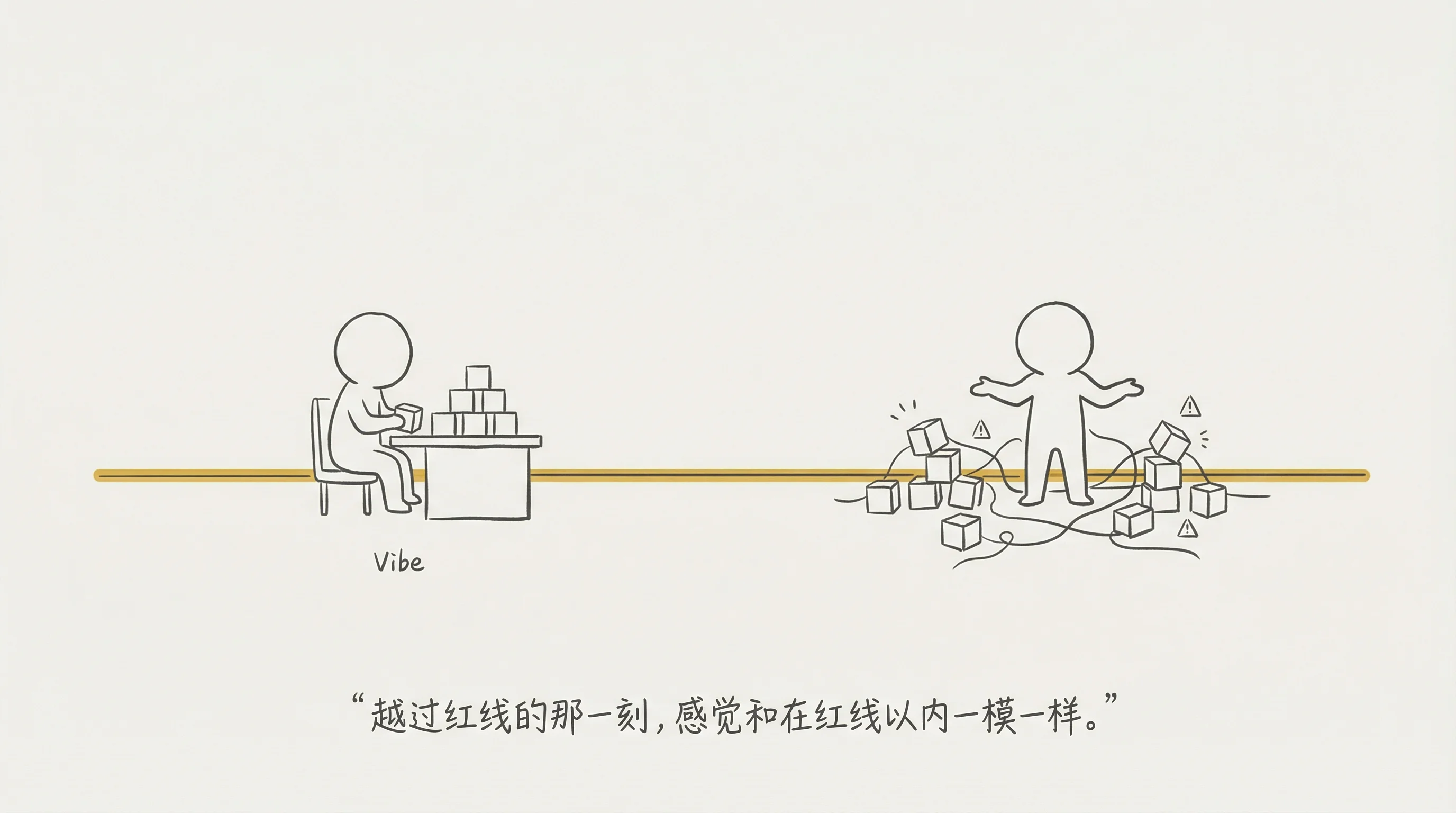
OpenClaw’s story makes one thing clear: Vibe Coding has an invisible red line. Inside the line, it’s an accelerator. Cross it, and it’s a ticking time bomb.
The most dangerous part is that the moment you cross the red line, it feels identical to being inside it. Just as fast, just as smooth, just as much “everything under control.”
Until one day you run an upgrade, and everything shatters.
Copyright
- Author
- XingKaiXin
- Title
- When Vibe Coding Meets a Million Lines of Code: What OpenClaw Taught Me
- Published
- 2026年4月2日
Licensed under CC BY-NC-ND 4.0 DEED.