

Last month I wrote a post about the MCP protocol and how it is becoming the “USB-C port” for AI. After it went live, the most common question in my inbox was:
“What about Google’s A2A protocol? How does it relate to MCP? Is it meant to replace MCP?”
I have been asked this at least ten times, so today I want to clear it up.
The short answer first: MCP and A2A are not competitors—they solve completely different problems. Yet most people mix them up, including developers who are already using both protocols.
Confusing them is costly. Pick the wrong protocol, and your architecture will fight you at every step down the road.
1. The Difference in One Sentence
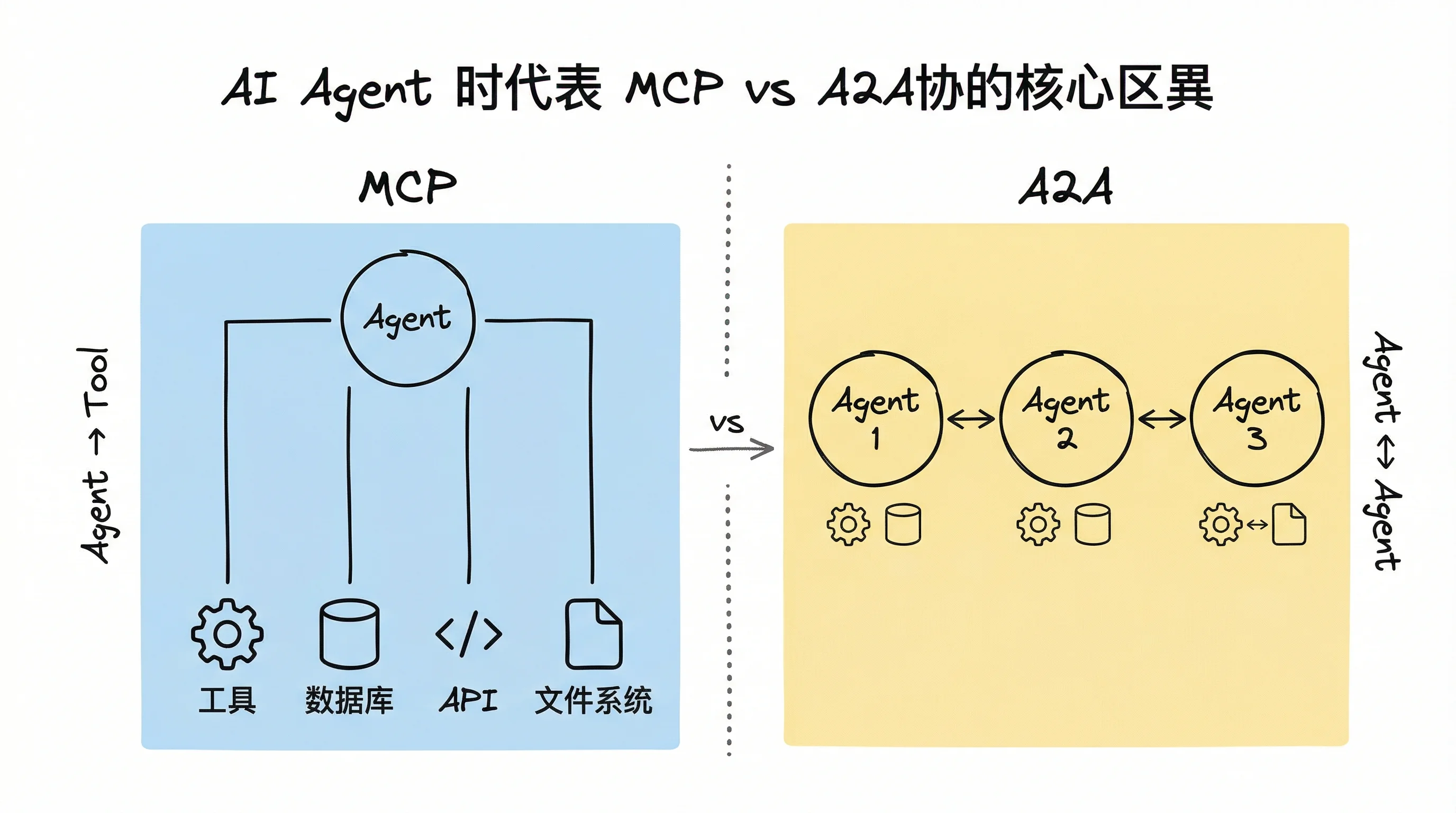
MCP handles what happens between an Agent and its tools. A2A handles what happens between one Agent and another.
It really is that simple. But “simple” does not mean “obvious.” Let me unpack this with an analogy you can feel right away.
Think about renovating a house.
MCP lets you find and use specialized tools and tradespeople. You call a plumber to fix the pipes, an electrician to run the wiring, and a painter to coat the walls. Each worker shows up, finishes the job, and leaves. MCP ensures you can “invoke” these workers in a standardized way without learning a different communication style for each one.
A2A is like hiring a general contractor to manage the whole project. The contractor knows which workers have which skills (through the “Agent Card” discovery mechanism), sequences the work (task orchestration), makes sure the plumber finishes before the electrician steps in (state synchronization), resolves issues when something breaks (exception handling), and delivers a finished result.
Without MCP, workers (Agents) cannot even use their tools. Without A2A, a crowd of workers stands around on site ignoring each other.
In technical terms: MCP is like standardized function calling, where an Agent uses MCP to invoke external resources such as databases, APIs, and file systems. A2A is like a communication protocol between microservices, where multiple Agents discover each other, delegate tasks, and exchange results.
Simple as this distinction is, it directly dictates which protocol you reach for in a given scenario.
2. Walking Through a Concrete Scenario
Concrete scenarios beat abstract concepts. Suppose you are building an AI travel assistant, and the user says: “Plan a trip to Hawaii for me, budget 20,000 RMB, 4 days and 3 nights.”
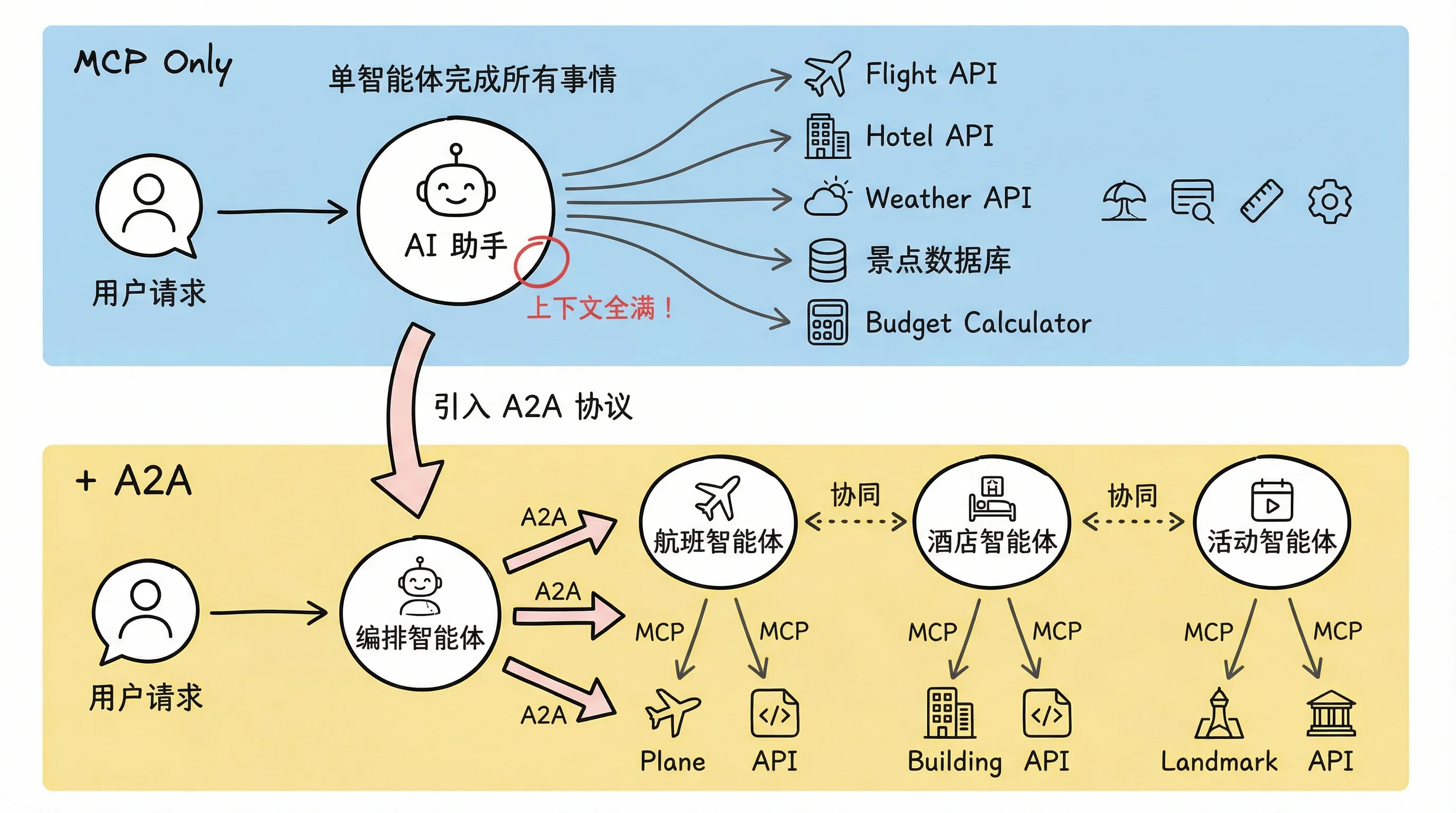
A World With Only MCP
Your AI assistant is a single Agent. It uses MCP to call a flight search API for ticket prices, a hotel booking API for room rates, a weather API for next week’s forecast, and an attractions database for recommended activities.
The data is in. But every bit of coordination that follows—comparing flight prices across dates, adjusting activities based on hotel location, and making trade-offs under the 20,000 RMB budget—has to happen inside this single Agent in one reasoning pass.
Once the task gets complex enough, the Agent’s context window fills up with raw data and reasoning quality drops fast. It starts making silly mistakes: recommending a hotel that is already sold out, scheduling the return flight before the arrival date, or miscalculating the budget.
A single Agent + MCP architecture is like a full-stack engineer doing everything solo. No matter how capable they are, once a project passes a certain complexity threshold, things break.
Adding A2A
Now your AI assistant no longer works alone. Over the A2A protocol, it discovers three specialized Agents: a Flight Agent, a Hotel Agent, and an Activities Agent. Each Agent has an “Agent Card” describing what it is good at, what input formats it accepts, and what results it returns.
Your assistant Agent breaks the task down:
- It sends a task to the Flight Agent: “March 20 to 24, departing Shanghai, destination Hawaii, budget cap 8,000 RMB.” Upon receiving the task, the Flight Agent calls flight search APIs via MCP, compares airlines, and returns the best option.
- It sends a task to the Hotel Agent: “Hawaii, March 20–23, budget cap 6,000 RMB, prefer near Waikiki Beach.” The Hotel Agent calls hotel APIs via MCP and returns three candidate hotels.
- It sends a task to the Activities Agent: “4-day Hawaii itinerary, remaining budget 6,000 RMB, staying in Waikiki.” The Activities Agent calls attractions databases and review APIs via MCP to build a day-by-day plan.
Results from all three Agents flow back to your assistant Agent via A2A. The assistant notices that the best flight from the Flight Agent is a late-night arrival, which conflicts with the Activities Agent’s Day 1 schedule. So it uses A2A to ask the Activities Agent to adjust Day 1—a round of Agent-to-Agent negotiation that requires zero input from you.
In the end, you get a complete, internally reconciled travel plan.
The key distinction is this: MCP operates inside each Agent (an Agent calling tools), while A2A operates between Agents (Agents dividing labor and collaborating). Each does its job at a different layer.
3. A Quick Technical Comparison
If you want a sharper view of how they differ, here are the core points:
They solve completely different problems. MCP solves Agent-to-tool connectivity (like a USB port), while A2A solves Agent-to-Agent collaboration (like HTTP).
Their interaction models differ as well. MCP is request-response and mostly synchronous: the Agent calls a tool, gets a result, and moves on. A2A supports multi-turn conversations and long-running asynchronous tasks, allowing Agents to go back and forth, check status, and adjust mid-flight.
Discovery works differently too. An MCP Server registers a list of tools to tell the Agent what it can do. An A2A Agent Card describes not only capabilities, but also authentication requirements, interaction modes, and supported data formats—because Agent-to-Agent collaboration is far more complex than calling a tool.
On task management, MCP has no concept of a task lifecycle; each call is standalone. A2A supports a full task lifecycle: created, working, input-required, completed, and failed. For complex jobs that may run for hours, that is a hard requirement.
In terms of ecosystem scale, as of March 2026, MCP SDK monthly downloads have crossed 97 million, with adoption across Anthropic, OpenAI, Google, and Microsoft. A2A has 50+ partners, and IBM’s ACP protocol has been merged into A2A. Both protocols now sit under the Linux Foundation’s Agentic AI Foundation (AAIF). Having the same foundation govern both protocols says it all: officially, they are complements, not rivals.
4. Which One Should You Learn Right Now?
This is the practical question everyone cares about most. My advice is straightforward:
Most People Should Learn MCP First
The reason is simple: the vast majority of AI applications today are still in the “single Agent + tool calling” stage. Having an Agent query a database, call an API, or read files—all of that belongs to MCP. The MCP ecosystem is already mature, with official MCP Servers for GitHub, Slack, PostgreSQL, Sentry, Google Drive, and other mainstream services. You can spend a few hours over a weekend getting an MCP integration running and put it to work right away.
Learn A2A When One Agent Starts Feeling Like Not Enough
When do you hit that point? Usually you will see a few signals: your Agent needs to call more than 5–6 tools in a single task, its context window keeps filling up, tasks have multiple steps with dependencies between them, and you start thinking, “I wish I could split this across a few specialized Agents.” That is when to bring in A2A.
A Common Misconception: Will They Merge Into One Protocol?
Not in the short term. They solve problems at different layers—just as TCP and HTTP never merged, even though HTTP runs on top of TCP. Over the long run, though, a unified developer experience is the trend. With both protocols already under the same foundation, middleware layers will likely emerge to simplify integration for developers.
Another Common Confusion: How Is This Different From REST APIs?
Many people ask, “Can’t I just call a REST API directly? Why use MCP?” The difference is autonomy in discovery and decision-making.
When you write a REST call, you decide at coding time what to call, how to call it, and in what order. Everything is hardcoded.
When an Agent works through MCP, it discovers available tools at runtime and decides on its own which one to call and what parameters to pass. When an Agent works through A2A, it discovers other Agents at runtime and decides which tasks to delegate.
REST APIs mean “a programmer hardcoded the call chain”; MCP/A2A mean “the Agent assembles the call chain at runtime.” That difference determines whether an AI application can actually handle open-ended tasks that cannot be fully predefined upfront.
5. Seeing the Full Picture
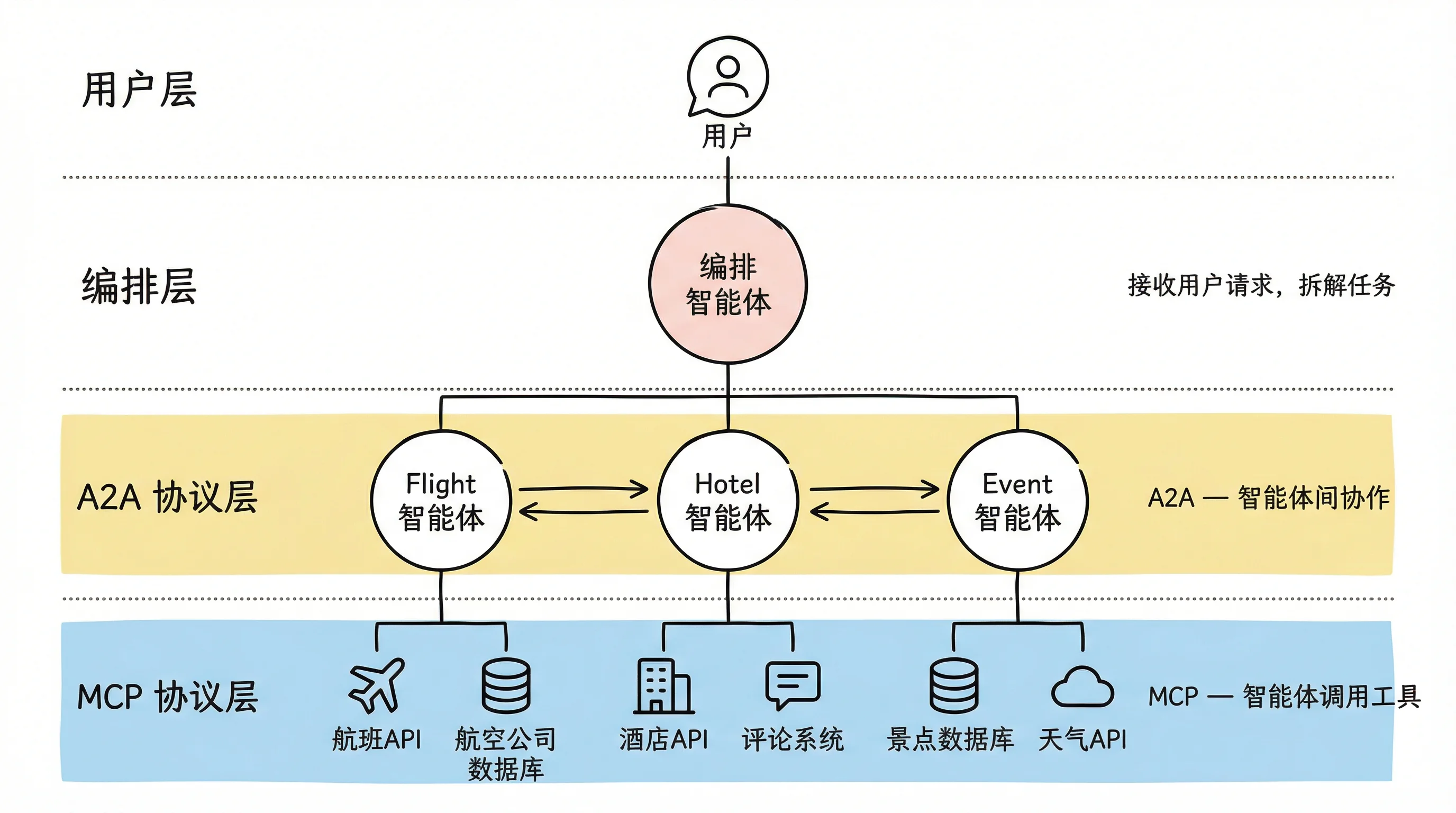
Put MCP and A2A together in a complete architecture, and the picture looks like this:
At the top is the user, talking to an “Orchestrator Agent.” The Orchestrator Agent communicates with multiple specialized Agents below it via A2A—assigning tasks, collecting results, and resolving conflicts. Inside each specialized Agent, MCP is used to call whatever tools and data sources that Agent needs.
Last time I said MCP is the “USB-C port” for AI. With A2A added, the picture is complete: MCP is the USB-C port on each Agent, and A2A is the LAN connecting all Agents together. Making a single device useful is MCP’s job; making devices work together is A2A’s job. Without either one, the system is incomplete.
That is also why enterprise AI competition in 2026 is no longer about “which LLM you use.” Models are commoditizing—whether you run Claude, GPT, or Gemini, the gap keeps shrinking. The real competition sits in the underlying architecture: Can your Agents call tools efficiently? Can multiple Agents collaborate reliably? Can the whole system stay secure, auditable, and scalable?
The answers to those questions live inside seemingly “boring” protocol layers like MCP and A2A.
Closing
This is the third post in the “AI Architecture Deep End” series.
In the first post, we covered GEO poisoning—where the evidence layer of a RAG architecture gets polluted and AI “trust” breaks down. In the second, we looked at the shift from Vibe Coding to Agentic Engineering—where a developer’s role moves from “writing code” to “directing Agents.” This post covered MCP and A2A—Agents need tools to get work done (MCP), and they need rules to collaborate with each other (A2A).
Looking across all three posts, a single thread runs through them: AI is turning from “a smart chatbox” into “a system that can act, collaborate, and also be manipulated.”
Understanding this system’s architecture—where its capabilities end, where its boundaries sit, and where its risks lie—is something our generation of developers cannot afford to skip. Take it step by step.
Are you already using MCP in your current projects? Have you started looking into multi-Agent collaboration? Share your real-world experience in the comments.
If you found this series helpful, give it a like and share it so more builders can see it.
Copyright
- Author
- XingKaiXin
- Title
- MCP vs A2A: Two Protocols in the AI Agent Era—Which Side Should Developers Pick?
- Published
- 2026年3月29日
Licensed under CC BY-NC-ND 4.0 DEED.