

Last month, I helped a friend debug a production service that kept freezing at random.
The endpoint itself was dead simple: after a user pays, redeem a coupon, update the order status, and send a notification. They had generated the whole thing in one shot with an Agent. The PR came with eight unit tests, ran blazingly fast against a local SQLite database, and hit 100% coverage.
Then they ran a load test in staging. As soon as concurrency climbed to three or four hundred, the entire service deadlocked and drained the database connection pool in seconds.
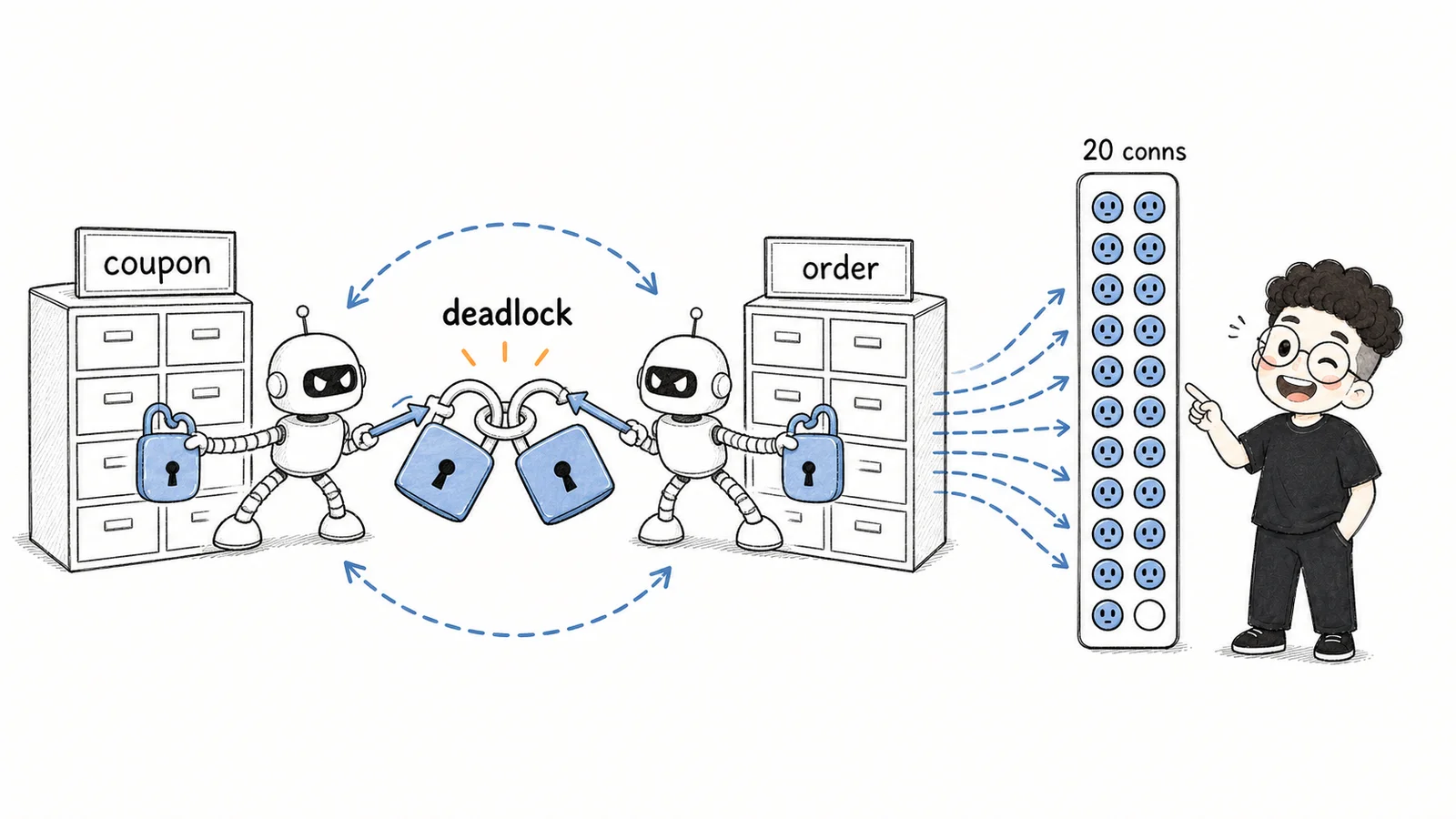
Digging in, we found that the Agent-generated code queried the user coupon table with an exclusive lock first, then checked the order status. Meanwhile, an async reconciliation job acquired those locks in the exact opposite order. On top of that, network timeout retries were casually set to three immediate attempts—so the moment a downstream gateway hiccupped, retry storms wiped out the underlying connection pool.
Over the past few months, one claim has been making the rounds everywhere in tech: “Writing code was never the hard part—figuring out the requirements is.”
The pitch is that typing and writing logic have become cheap manual labor. Future developers, supposedly, will only need to understand the product and the business, describe what they want in plain words, and hand the rest off to AI.
It sounds effortless. But anyone who has lived through a few real production outages knows this is pure fantasy.
Requirements Are Wishes; Code Is Rigorous Accounting Against Physics
Many people think “figuring out the requirements” is the highest-leverage skill because they picture requirements as a single plain-English sentence: “Build an e-commerce system with automatic refunds on payment timeouts that can handle high-concurrency flash sales.”
Saying that sentence takes two seconds. In engineering terms, every single word in it demands a price from the underlying hardware:
- When a downstream payment gateway returns a 504 timeout, did the charge go through or not? Which intermediate state is your local state machine stuck in?
- When a message queue replays a charge event from half an hour ago, does your idempotency key live in Redis or get enforced by a unique index in the database?
- Behind a PgBouncer pool with only 20 connections, if a single long transaction stalls for 500 ms, will it push the service’s health check probe past its timeout and trigger a cascading Kubelet container restart loop?
Those concrete details—buried in state machines, race conditions, rollback paths, and connection pool settings—are what make a software system actually work.
Translating natural-language intent into clean-looking syntax takes AI only a few seconds.
What AI has no idea about is which version of PostgreSQL you run in production, the 15 ms jitter on your cross-AZ network calls, or the fact that your garbage collector configuration will trigger a multi-hundred-millisecond Stop-the-World pause during a spike in short-lived objects.
Baking those unforgiving physical constraints into every line of code and error handler has never been cheap grunt work. It is the hardest step in the entire engineering pipeline.
What Looked Like Saved Effort Turns Into Dirty Debugging Work
The barrier to typing and churning out boilerplate really has dropped to zero.
Writing an HTTP client with retries used to mean reading docs, configuring backoff, and handling connection reuse—half an hour by hand. Now an Agent spits it out at the press of Enter.
That hasn’t made writing good code any easier. It has only made the bugs harder to spot.
When you wrote code by hand, every line passed through your head. You instinctively asked whether a pointer could be nil or whether a map needed a mutex under concurrent access.
Now an Agent dumps two hundred lines of syntactically spotless code in one go, all unit tests pass, you skim it, think it looks tidy, and merge it to main. Then at 2 a.m. on a Sunday, the monitoring dashboard lights up. You dig through logs across a dozen microservices, only to find an unclosed channel buried inside a third-party SDK, slowly eating all the memory.
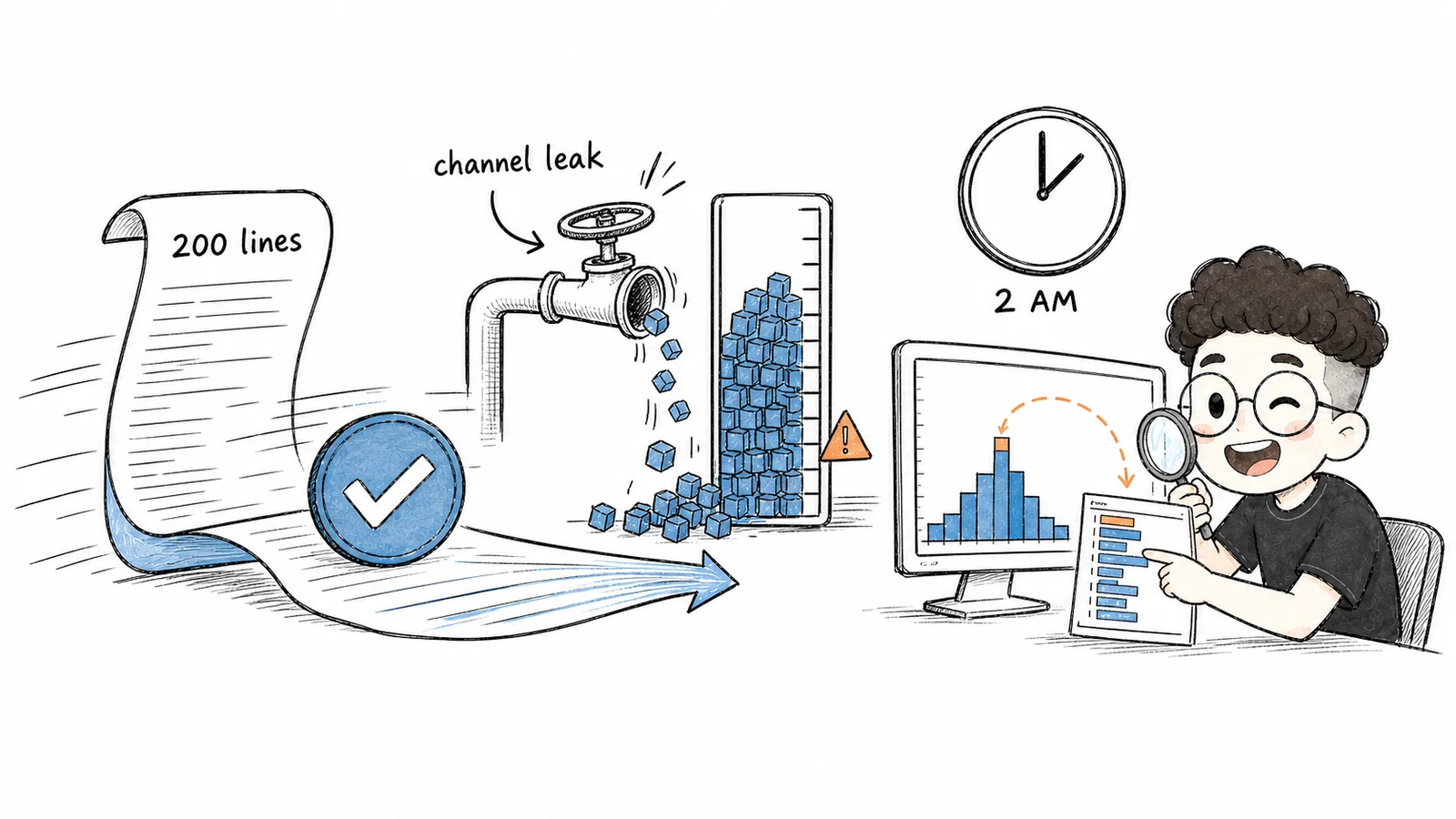
At that moment, the person who kept repeating “just think through the logic” is completely stuck.
The one who actually saves the system is still the engineer who knows Linux process states, can read a CPU Flame Graph, and can trace a deadlock to a memory address in GDB or a stack dump.
Who Actually Holds the Line
If writing code were truly easy, computer science wouldn’t have spent the last several decades publishing thousands of papers on concurrency models, memory safety, and transaction isolation levels. If code were just translating intent, production systems around the world wouldn’t be generating incident postmortems every single day.
All AI removed is the mechanical cost of keystrokes and memorizing APIs.
It stripped away the filler in the craft of programming. What remains—understanding system boundaries, defending failure paths, and respecting real physical resources—has only become more valuable than ever.
Don’t get fooled by breezy slogans.
There is no shortage of people who can pitch a grand vision. But when real traffic hits, the only person who can hold the line and make every line of code stand up in the physical world is the one who actually understands how instructions run on the machine.
Copyright
- Author
- XingKaiXin
- Title
- "Code Was Never the Hard Part" Is the Biggest Myth About Programming
- Published
- 2026年9月21日
Licensed under CC BY-NC-ND 4.0 DEED.