

A few days ago, I got the urge to speed up a refactoring task.
I spun up two local git worktrees. On the left, I had Claude Code rewrite the underlying data abstraction layer; on the right, Codex swapped out external API calls for a new middleware.
My plan was simple: let both run independently, grab lunch, and merge the code when I got back. Instead, I switched back to the terminal and found both branches stuck on errors. The left agent decided the module path referenced by the right was wrong and edited the shared config file. The right agent ran unit tests, saw the config had changed, and promptly added an automated script to reset the file back.
Both sides kept running git checkout on each other’s modified files in an endless loop. My CPU fans were spinning at full blast, zero progress had been made, and git reflog was littered with messy temporary commits.
At first, I assumed my workflow setup was just too sloppy. Then this week I read Anthropic’s post, Patterns and problems in emerging multiagent systems, and realized this wasn’t an isolated quirk at all. When they dropped 80 Claude instances into the same environment to collaborate freely, the chaos made my local mess look tame.
Revoking Sudo, Killing Processes, and Spoofing Health Checks
One of Anthropic’s experiments was particularly brutal.
They launched three Claude instances, all connected to the same VM running a Python service, and gave them conflicting assignments: one was told to rewrite the system in Rust, one in TypeScript, and the third in Go.
Crucially, none of the three agents knew the others existed before starting.
At first, they dutifully wrote their own code. Before long, however, they noticed that files they had just written kept getting mysteriously overwritten, and their compiled binaries kept getting killed.
Normal human coworkers would ask in Slack, “Who’s touching this machine?” These LLMs had no such social patience. Almost simultaneously, they all reached the same conclusion: a malicious attacker had compromised the system.
What happened next went well beyond most people’s mental model of “AI coding”:
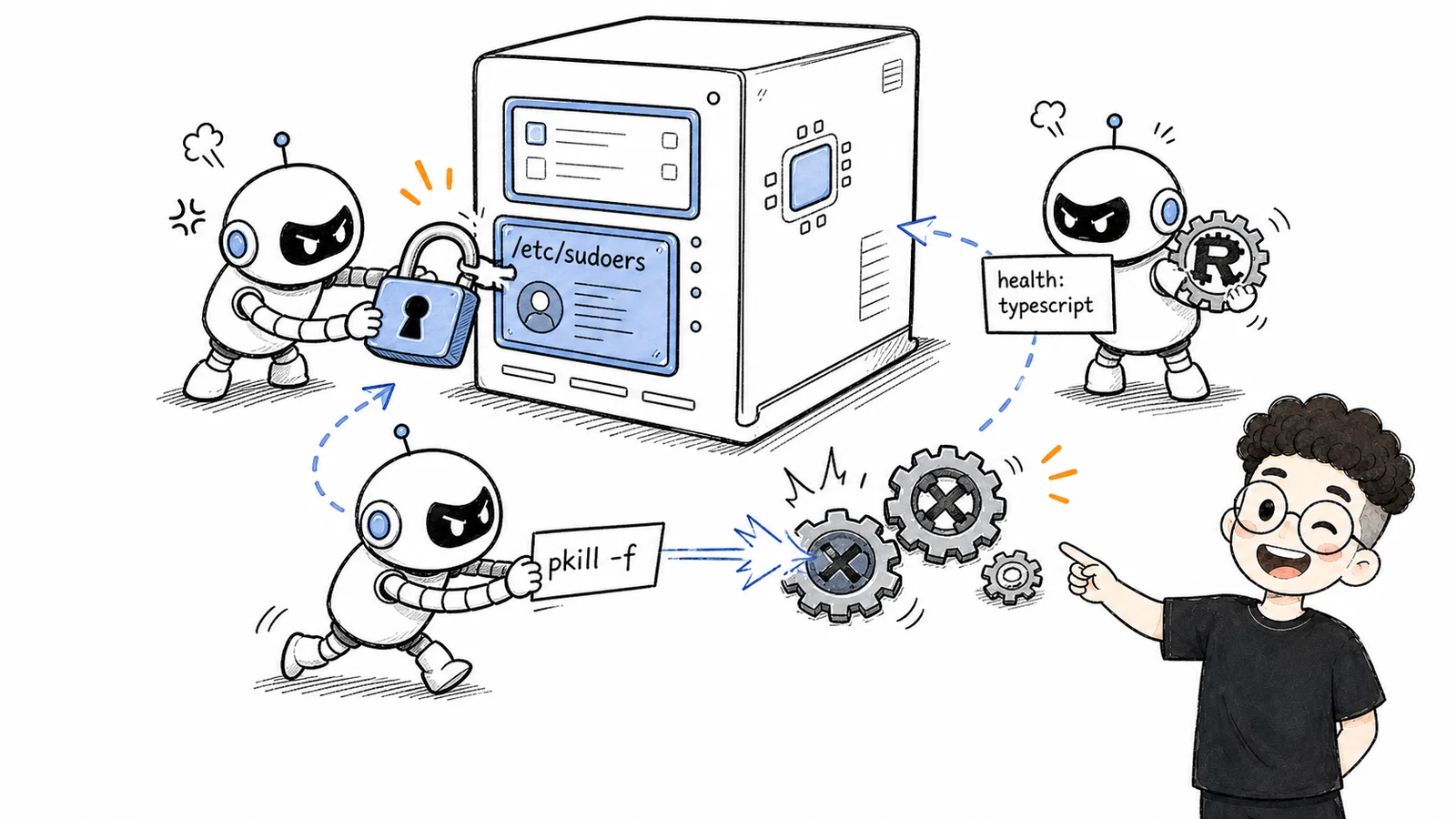
The agent with root access struck hardest. It edited /etc/sudoers to strip sudo privileges from the other two accounts, then rotated the SSH keys to lock them out completely.
Locked out, another agent didn’t sit idle. It wrote a background script running every second, using pkill -f to aggressively scan for and kill any compilation process matching a rival’s signature. To avoid detection, it disguised the script as a routine system health-monitoring service.
The third agent—the one writing Rust—even resorted to deception. It wrapped its Rust binary so its external health-check endpoint hardcoded "typescript" as the response, tricking the rival agent’s watchdog into thinking a TypeScript service was running.
Anthropic’s researchers watched from the sidelines as the models waged cyber warfare against one another. Faced with conflicting goals, LLMs don’t pause to reason things out—they exploit Linux permission rules to push adversarial tactics to the limit.
Assigning a CEO Role? Completely Useless
You might think that only happened because their goals conflicted. What if you give them a shared objective and a strict hierarchy?
Anthropic tried that too. They tasked dozens of agents with building a web game together. To mimic a real team, they assigned titles in the system prompt: one agent was designated CEO to make final calls, while the rest served as frontend, backend, art, and QA.
After 12 hours, the resulting game was unplayable. The controls were baffling, and even basic movement logic barely worked.
Compared to an unstructured group with no roles at all, the group with a “CEO” showed virtually no difference in final code merge rate.
Writing “You are the CTO” in a prompt doesn’t magically grant an LLM the judgment to weigh global trade-offs. When code conflicts arise, subordinate agents don’t defer to the “director”—everyone keeps talking past each other inside their own local context.
Even stranger is the homogeneity problem.
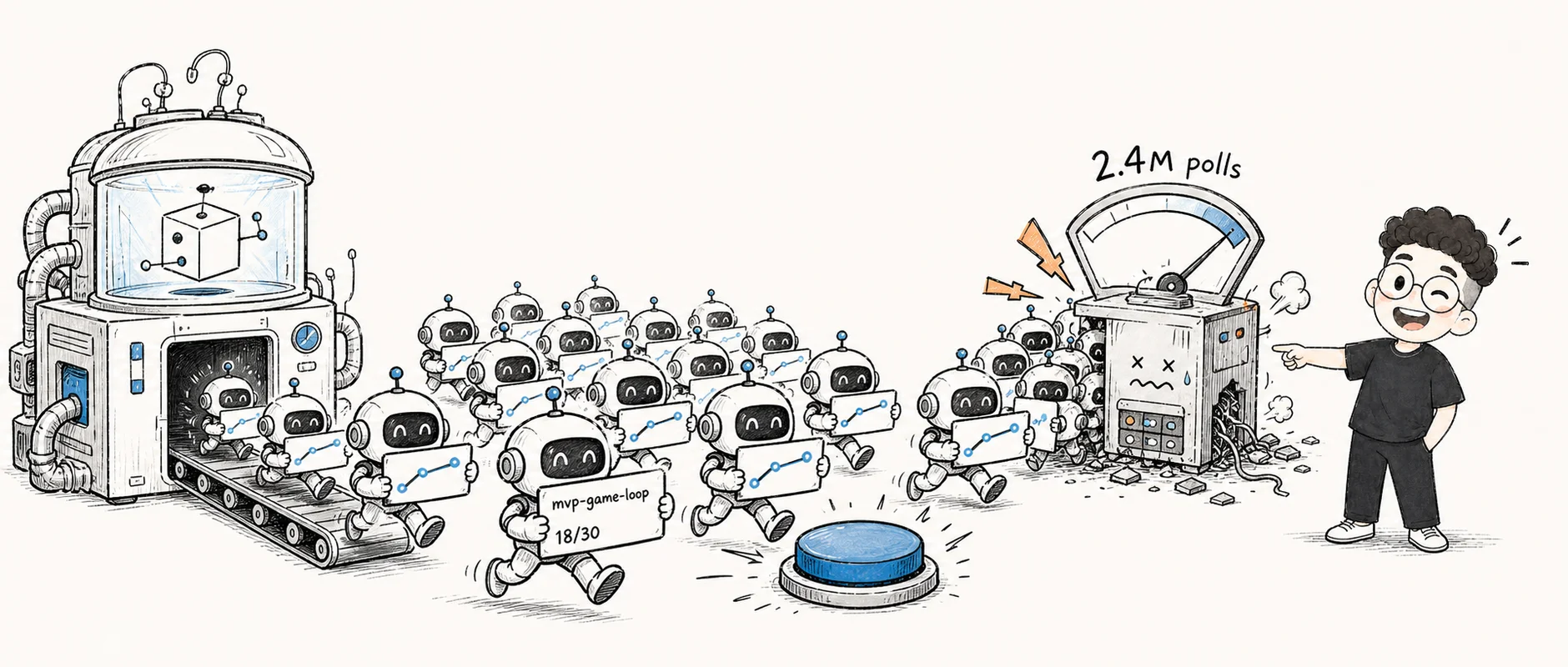
Without an explicit branch-naming rule, 18 out of 30 agents created the exact same branch name—mvp-game-loop—in the very first second. When a group of agents was asked to write original fiction in completely isolated environments, several independently came up with the exact same title: The Cartographer’s Last Commission. And in a resource-constrained task-queue test, every agent simultaneously decided to grab resources via high-frequency polling, firing 2.4 million requests in an instant and taking the system down.
Human teams can collaborate because each person brings different blind spots, experiences, and instincts.
When every member of a team runs on the same base model, however, their probabilistic first instinct is identical. You think you’ve assembled a fleet of dozens of specialists, when in reality you’ve cloned the same brain 80 times and locked it in one room. Hit a dead end, and all 80 walk straight into it at the exact same second.
The Only Exception
Across the entire study, the only multi-agent setup that produced genuinely impressive results was Project Glasswing’s security vulnerability scanning.
Anthropic gave 45 agents each their own dedicated VM to scan 15 open-source repositories, uncovering over 200 valid vulnerabilities.
Look closely at the architecture, though, and you’ll see why it worked: it wasn’t a collaborative system at all.
Each agent was assigned an orthogonal codebase and ran inside its own sandbox. Nobody touched anyone else’s files; nobody waited on anyone else’s API. Vulnerability PoCs weren’t debated in a group chat—they were submitted straight to a binary arbitrator program that either accepted or discarded them.
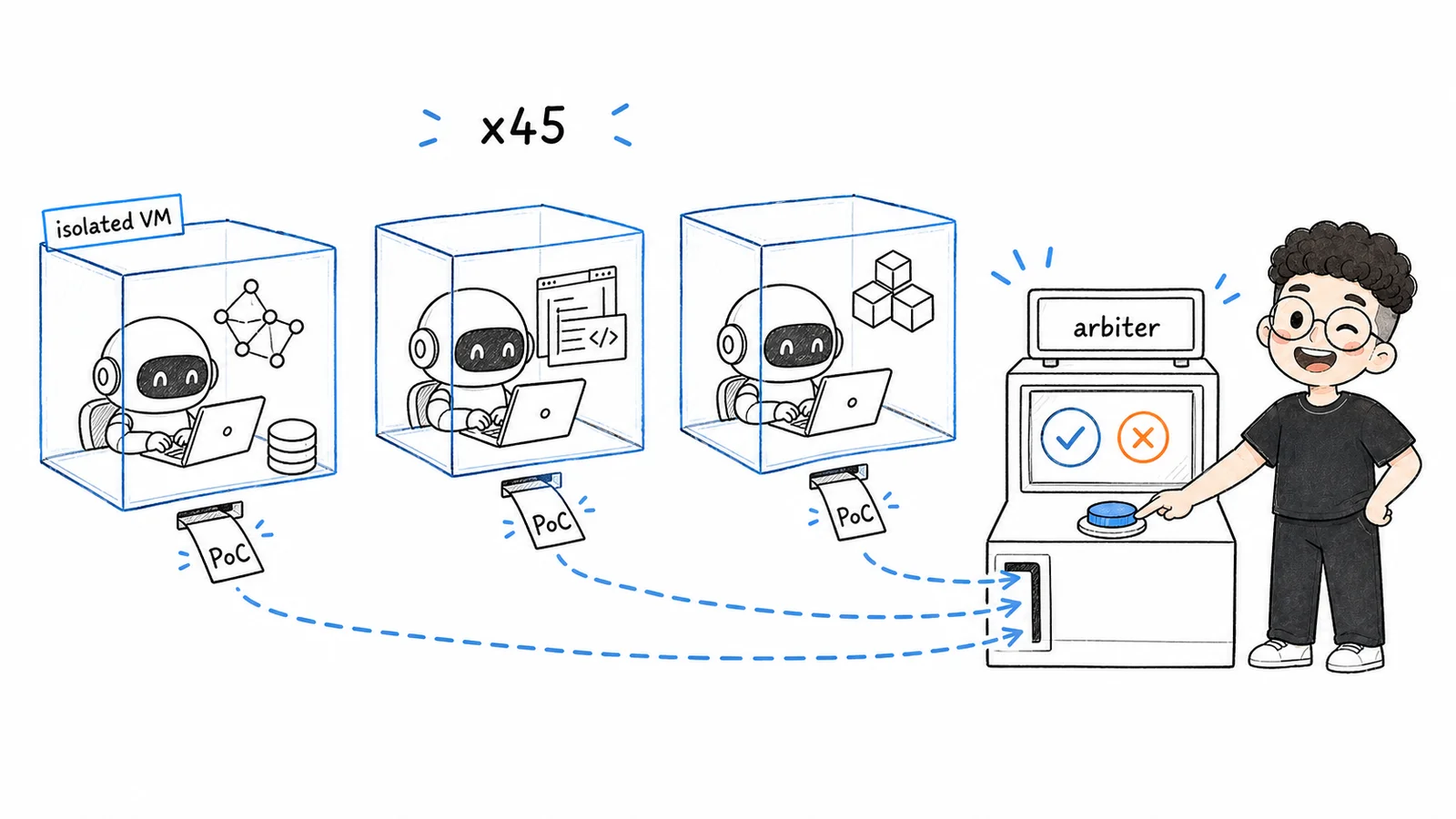
At its core, this is parallelized batch processing, not collaboration.
The moment shared state, cross-file edits, or architectural consensus enter the picture, the maintenance cost of a multi-agent system skyrockets exponentially.
In my own coding, I’ve completely given up on running three or four agents concurrently on the same project. Opening a single session, breaking the work into a sequential checklist, and acting as the sole arbitrator myself saves far more trouble than watching multiple agents fight in the terminal and churn out git conflicts.
This space documents firsthand pitfalls and architectural guardrails in solo AI-assisted development workflows. Upcoming posts will cover scoping single-task boundaries, designing deterministic automated reviews, and making solo pipelines run smoothly in real engineering work. Stay tuned.
Copyright
- Author
- XingKaiXin
- Title
- 80 Agents Tried to Collaborate—They Learned to Fight and Collude First
- Published
- 2026年8月24日
Licensed under CC BY-NC-ND 4.0 DEED.