

Last November, I asked Claude Code to write some logic for handling concurrent requests.
It immediately reached for a Mutex, added timeout control, and even wrote a graceful degradation fallback. Everything ran fine, all tests passed, I skimmed the diff, and merged it.
Later, while talking about concurrency control with a friend, he asked me, “Why didn’t you use a read-write lock for that scenario? A Mutex will cause performance issues when reads heavily outnumber writes.” I paused. He was right. My workload really was read-heavy. But AI gave me a Mutex, and I never thought to consider other options because its solution worked.
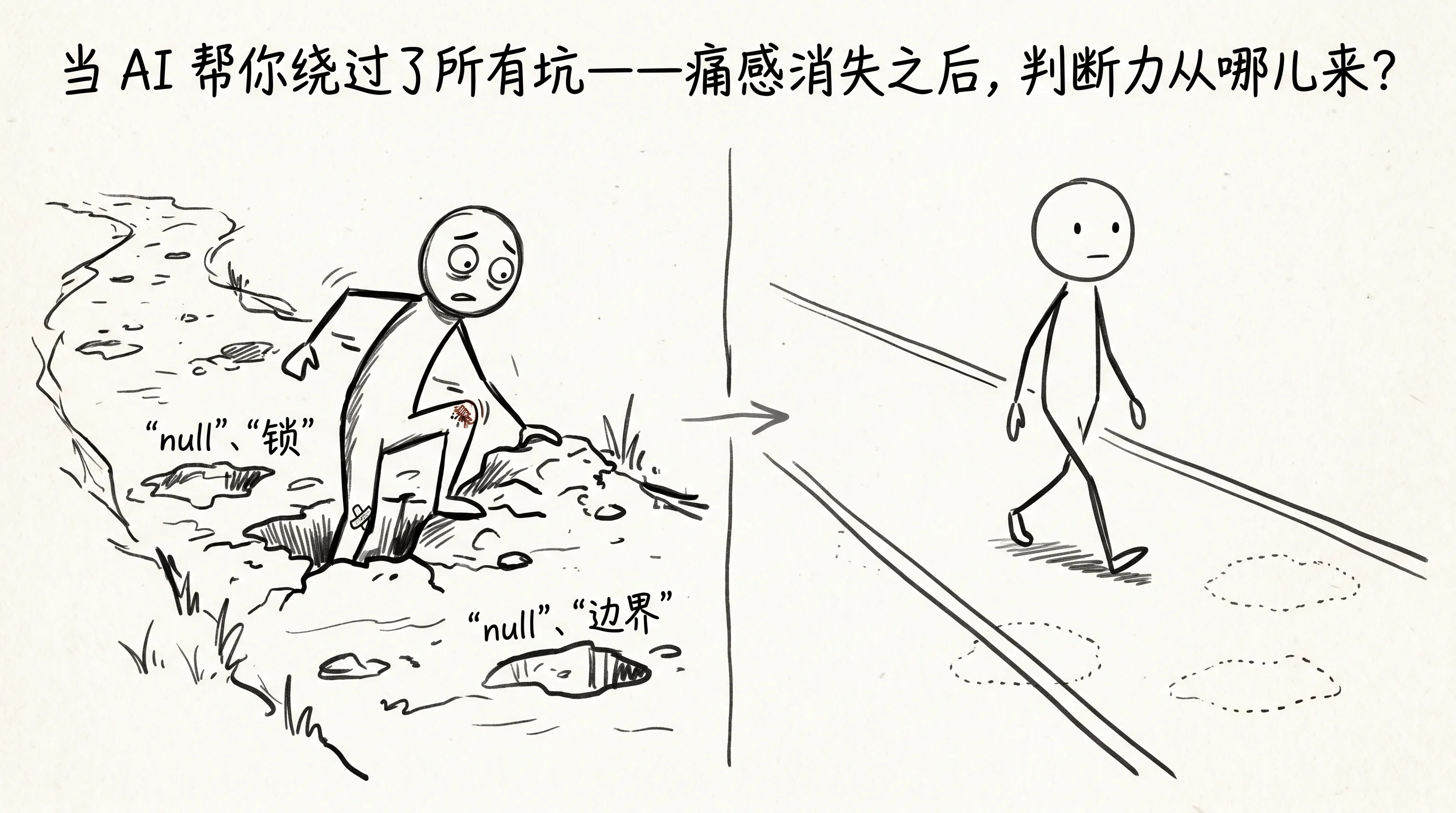
What made me even more uncomfortable was this: I had never experienced what happens when you don’t lock at all. I’d never seen a race condition corrupt data in production, nor did I have memories of being woken up at 3 a.m. by an alert to dig through logs. I knew the conclusion—“concurrency needs locking”—but I didn’t know the weight of that conclusion.
AI helped me bypass a pitfall. Yet that pitfall could have taught me something.
How Pain Turns Into Experience
Think back to the most deeply learned lesson of your career. Chances are, it’s tied to an incident.
I’ve asked seven or eight engineer friends the same question: “What’s the technical lesson that left the deepest impression on you?” Not a single one mentioned a book or a class. Every answer was an incident: locking up the database during a deploy, taking down the entire site with a misconfiguration, getting an endpoint hammered by SQL injection, or forgetting to handle time zones and throwing off a month of financial reports.
Every incident hurts. After the pain, you remember. The next time you run into a similar situation, a signal fires inside you: “Wait a second, I’ve stepped on this landmine before.”
That signal is intuition. Intuition isn’t a gift; it’s a conditioned reflex grown from being hurt.
Put plainly, learning works like this: you make a decision, something goes wrong, you retrospect on why it went wrong, and next time your judgment is sharper. That middle step—“something goes wrong”—is the linchpin of the whole chain. Without it, the retrospect and the growth in judgment never happen.
There’s an old saying in medical education: “See one, do one, teach one.” But the most important part isn’t the seeing or the teaching—it’s the part of “do one” where you mess up. An intern stitches crookedly the first time, the attending points it out, and next time the intern knows how to adjust the pressure. If a machine does the stitching for them, stitches it perfectly, and they just stand there watching, what did their fingers learn?
AI Is Paving Over the Pitfalls
What makes AI good at writing code is that it has seen so much code that it knows the “right way” for most scenarios. Ask it for a piece of logic, and it hands you a mature solution complete with common error handling. It won’t forget to lock, won’t forget null checks, and won’t forget bounds checking.
Those things it “won’t forget” are precisely the things you used to remember only after making mistakes.
The first time you forgot to handle null, the program crashed, and you remembered. The first time you forgot a bounds check, data overflowed, and you remembered. The first time you forgot to close a database connection, the pool exhausted, production paged, you got woken up in the middle of the night, and you remembered.
The moment AI generates code, it bypasses all of those pitfalls. Your codebase won’t have rookie mistakes like missing null checks, and your tests won’t fail on uncovered edge cases. On the surface, everything looks better.
But you never went through the “forgot, broke things, remembered” loop. You got the conclusion, while the process of arriving at it was skipped.
In an earlier post, I wrote: “AI treats every problem with the same attitude—confidence.” Here I want to add a corollary: Every solution AI gives you is also the same—clean. You never see it hesitate, try, fail, and correct itself. You only see the final output.
And that process of “hesitating, trying, failing, and correcting” is the entirety of human learning.
Apprentices Are Running Out of Grunt Work
This problem hits newcomers especially hard.
The traditional growth path for a software engineer is unglamorous: you start out writing CRUD, fixing small bugs, and running data migrations. Those tasks look low-skill, but they are the training ground. You mess up foreign key relationships while writing CRUD, read someone else’s code for the first time while fixing a bug, and learn the iron rule of “back up before you touch anything” while running a migration.
Every piece of grunt work teaches you something, even if you don’t realize it at the time.
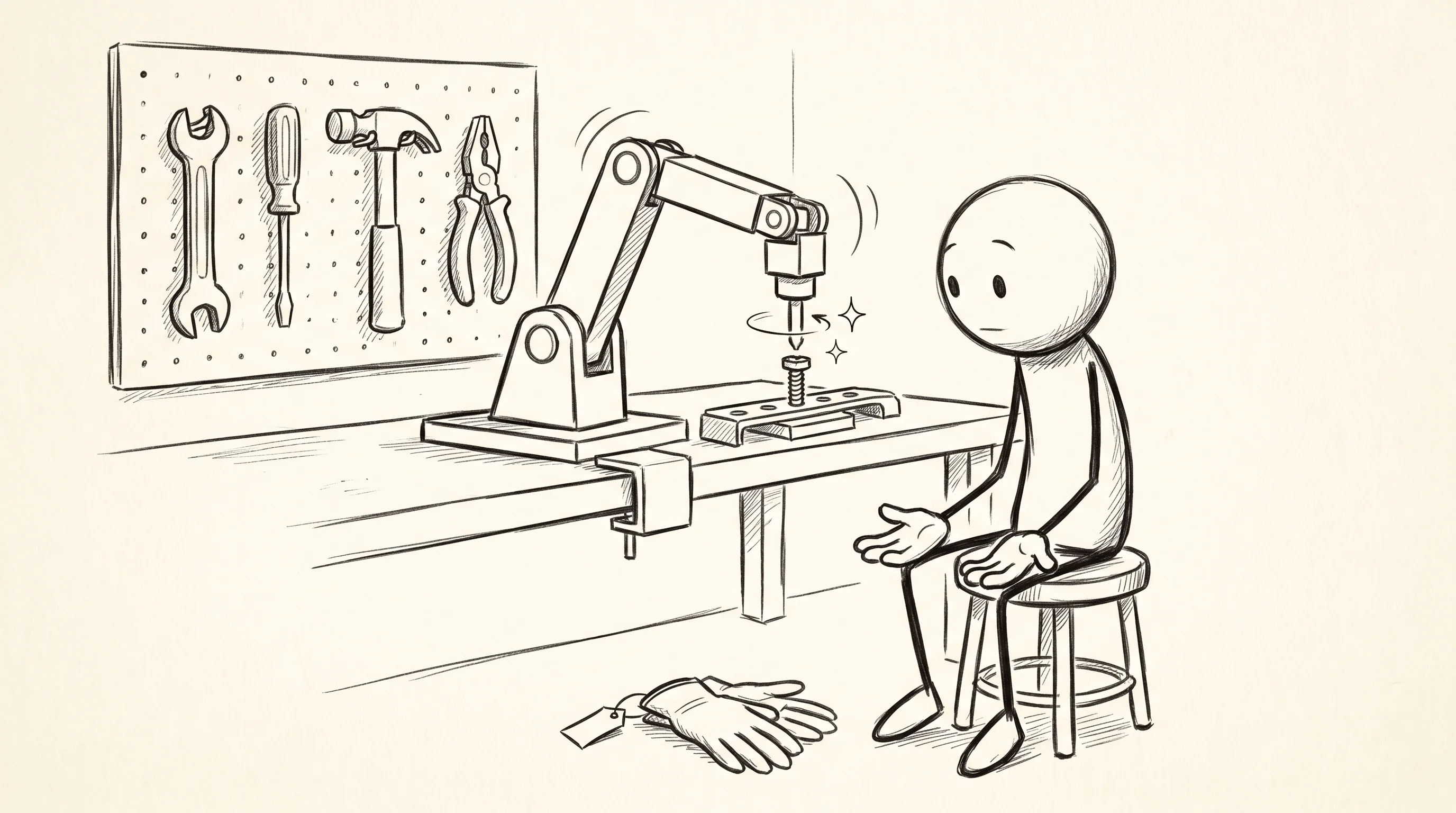
Now AI is taking over that work. CRUD? Claude Code finishes it in two minutes. Small bug? Paste the error message in and AI fixes it for you. Data migration? AI generates the script, you run it, and you’re done.
Efficiency went up. But the apprenticeship period is being compressed to near zero.
A junior engineer hired in 2024 and one hired in 2020 share the same “junior” title, yet the training density they experienced is completely different. The 2020 hire spent two years writing their own code, stepping into their own holes, and fixing them, building up a thick memory of mistakes. The 2024 hire used AI from day one—their output volume may be higher, but their depth of experience is much thinner.
Here’s an analogy you can probably feel right away: learning to drive. Used to be you had to grip the steering wheel yourself, work the clutch, stall the engine, get yelled at by the instructor, and start over. After messing up enough times, you developed a feel for the road. Now imagine someone hands you a self-driving car and puts you in the driver’s seat to “supervise” it. You watch it nail every lane change and every parallel park. But if one day the system fails and needs you to take over, where is your feel for the wheel?
The job market is already reflecting this shift. According to SignalFire, new-grad hiring at the top 15 U.S. tech companies dropped by 55% over the past few years, while demand for senior engineers rose. The market is telling you what it values: it’s willing to pay for judgment. Yet that judgment used to be accumulated slowly during the apprenticeship years.
The apprenticeship was skipped, but the market’s demand for judgment hasn’t dropped. Right now, nobody knows how to fill the gap in between.
Veterans’ Intuition Is Atrophying Too
If you think this is only a junior problem, let me share how it feels from my side.
After over a year of coding with AI, I’ve noticed my “first instinct” getting weaker in certain areas.
When I used to look at concurrency code, a few checklist items would pop into my head automatically: Is the lock granularity right? Is there a deadlock risk? How are timeouts handled? Those checks weren’t deliberate effort; they were automatic reflexes built from years of stepping on rakes, like looking both ways before crossing the street.
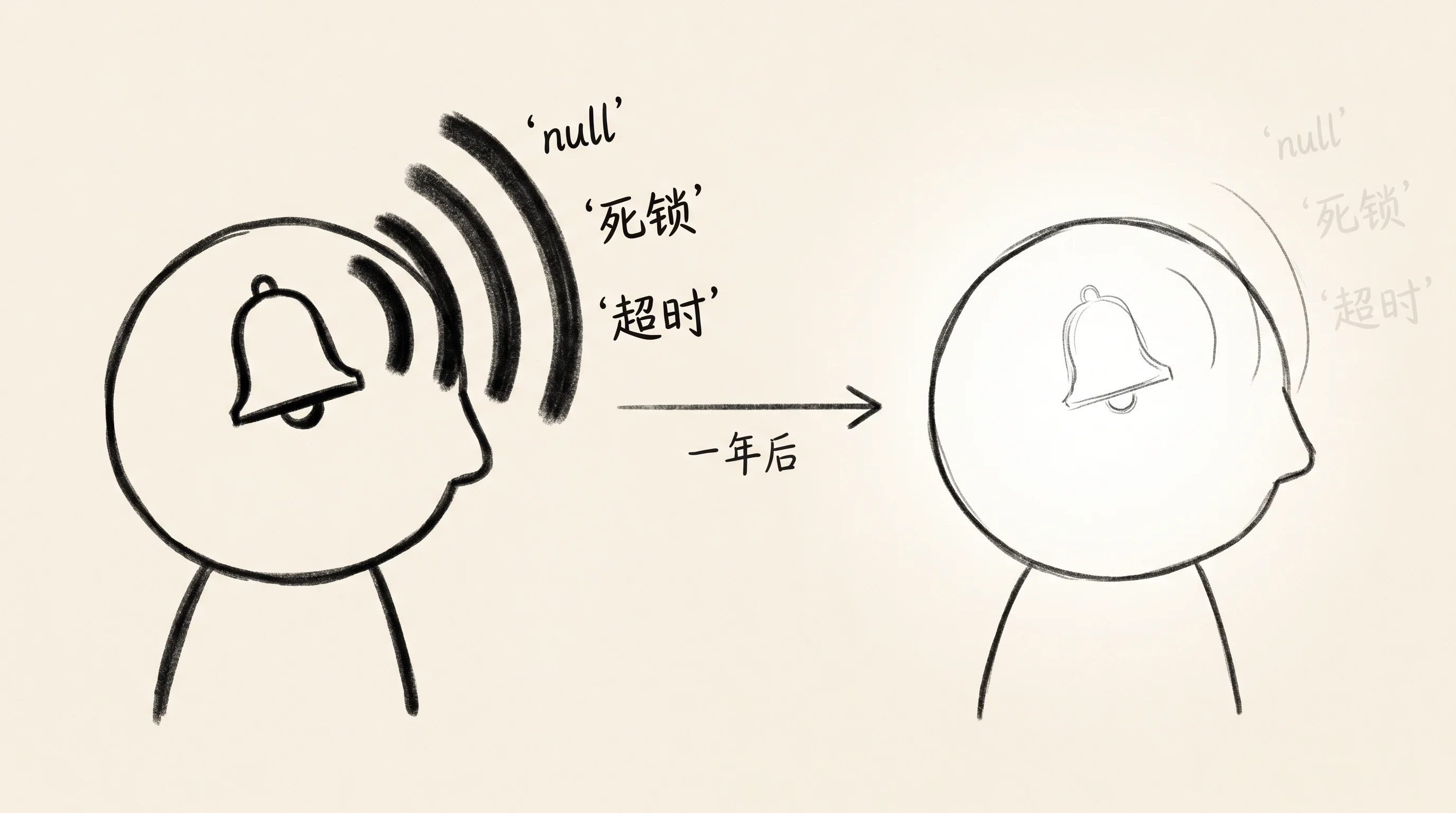
Now, when I look at concurrency code written by AI, my first reaction has become “looks fine.” Not because I inspected it carefully, but because AI writes code that is so clean—well-formatted, smooth logic, no obvious flaws on the surface. Those automatic checklist items are firing less often.
The junior problem is “never grew the muscle.” The veteran problem is different: the muscle exists, but it’s atrophying. And atrophy is more dangerous than never having it, because you fool yourself into thinking you’ve still got it. You assume the checklist is still running automatically in the background, when in fact it hasn’t been triggered in months. You skim a diff and think “looks good,” unable to tell whether that’s a real review conclusion or just your alertness threshold quietly drifting higher.
In another post, I quoted a reader’s comment: “That intuition when reading AI code—‘something feels off, though I can’t say why’—isn’t code review skill; it’s your body sounding the alarm for your metacognition.”
That alarm system needs to be fed continuously. What feeds it is the mistakes you made with your own hands, the bugs you fixed yourself, and the decisions you owned. As those sources shrink, the alarm grows quieter, until it’s too faint for you to notice.
Deliberately Manufacturing Pain
At this point you might ask: so what do we do, stop using AI?
Of course not. AI is a great tool. What matters is whether you realize what the tool is skipping for you.
Over the past few months, I’ve stumbled onto a few habits that work for me. Nothing systematic—just small routines to keep my feel sharp.
The most useful one: set aside a “bare-metal” coding slot every week. No AI, no autocomplete—start from a blank file and write it yourself. It doesn’t need to be long, half an hour to an hour. The goal isn’t output; it’s keeping your feel. Like a pianist practicing scales every day—the exercise itself has no performance value, but it keeps your fingers remembering the distance between keys.
Last month, I used my bare-metal time to write a WebSocket heartbeat check from scratch. Halfway through, I realized I had forgotten to handle reconnection on disconnect. If AI had written it, it would have included the reconnect logic automatically, and I wouldn’t even have noticed it was a scenario that needed thinking about. Because I wrote it myself, I went through the “forgot, noticed, patched” loop. Next time I touch WebSocket code, there will be one more item on my mental checklist.
Another habit is even simpler: after AI gives me a solution, before accepting it, I ask myself—“If I didn’t have AI, how would I write this?” You don’t need to actually write it out; just walk through it in your head. If you find you can’t come up with any alternative at all, that’s a sign you don’t understand the problem deeply enough, and you should probably think for ten minutes on your own before looking at AI’s output.
There’s also a question I added to my retrospectives: “If I hadn’t used AI this time, at which step would I have made a mistake?” This question helps you see the pitfalls AI steered you around. Once you see them, you can deliberately fill that gap in your knowledge. If you don’t see them, that blind spot stays right where it is—until one day it turns into a production incident you don’t know how to handle.
All of these habits come down to the same thing: deliberately creating learning opportunities for yourself. You’ll move a little slower. What you get back in return is a real grip on your code, and an alarm system that actually stays on.
When was the last time you wrote a complete piece of code from scratch, without any help from AI?
Copyright
- Author
- XingKaiXin
- Title
- When AI Bypasses Every Pitfall: Without the Pain, Where Does Judgment Come From?
- Published
- 2026年4月16日
Licensed under CC BY-NC-ND 4.0 DEED.