

Looking back at 2025, it was a year of deliberately expanding my cognitive boundaries while continuing to sharpen my craft. My focus shifted from data infrastructure and foundational systems in the first half of the year to refining workflows, standards, and end-to-end execution on complex projects in the second half. At the same time, I intentionally avoided confining my technical path to a single vertical, building intersections across system performance, data modeling, AI, and interdisciplinary knowledge.
This year reinforced a conviction for me: long-term value comes not from stacking more skills, but from accumulating abstraction and judgment.
Since ChatGPT rolled out its memory feature, many users experienced the feeling of “being remembered” for the first time. You tell it you like Japanese food, and weeks later it proactively recommends a sushi spot nearby. That subtle shift turns an AI assistant from a cold tool into a companion with “memory.”
Yet in agent development, that experience is still rare. Today you tell your coding assistant, “Our project uses camelCase,” and tomorrow it has completely forgotten. Developers end up stuffing more and more context rules into prompts—making prompts longer, harder to maintain, and yet forgetting happens more often than ever.
Memory is not prompt stuffing; it is a system capability. In this post, I want to look at what core problems we actually need to solve if we want AI to have true long-term memory.
The Ceiling of Vector Stores
Most AI memory solutions today follow a similar pattern: convert conversation content into vectors, store them in a vector database, and recall relevant memories via similarity search when needed. This architecture is simple, intuitive, and does solve part of the problem.
Honestly, though, it behaves more like a searchable log system than real memory.
Think about how the human brain works. You don’t store every single day of the past twenty years verbatim; you continuously compress, distill, and update. You may have long forgotten what you had for breakfast last month, while learning to ride a bike in elementary school remains crystal clear. Memory is selective—it evolves, conflicts, and needs consolidation.
A vector store cannot do any of this. It faithfully saves every record and returns the most similar ones when queried. That solves the problem of “finding relevant information,” not “managing knowledge.”
A true memory system has to face three core challenges.
Memory Compression: From Logs to Knowledge
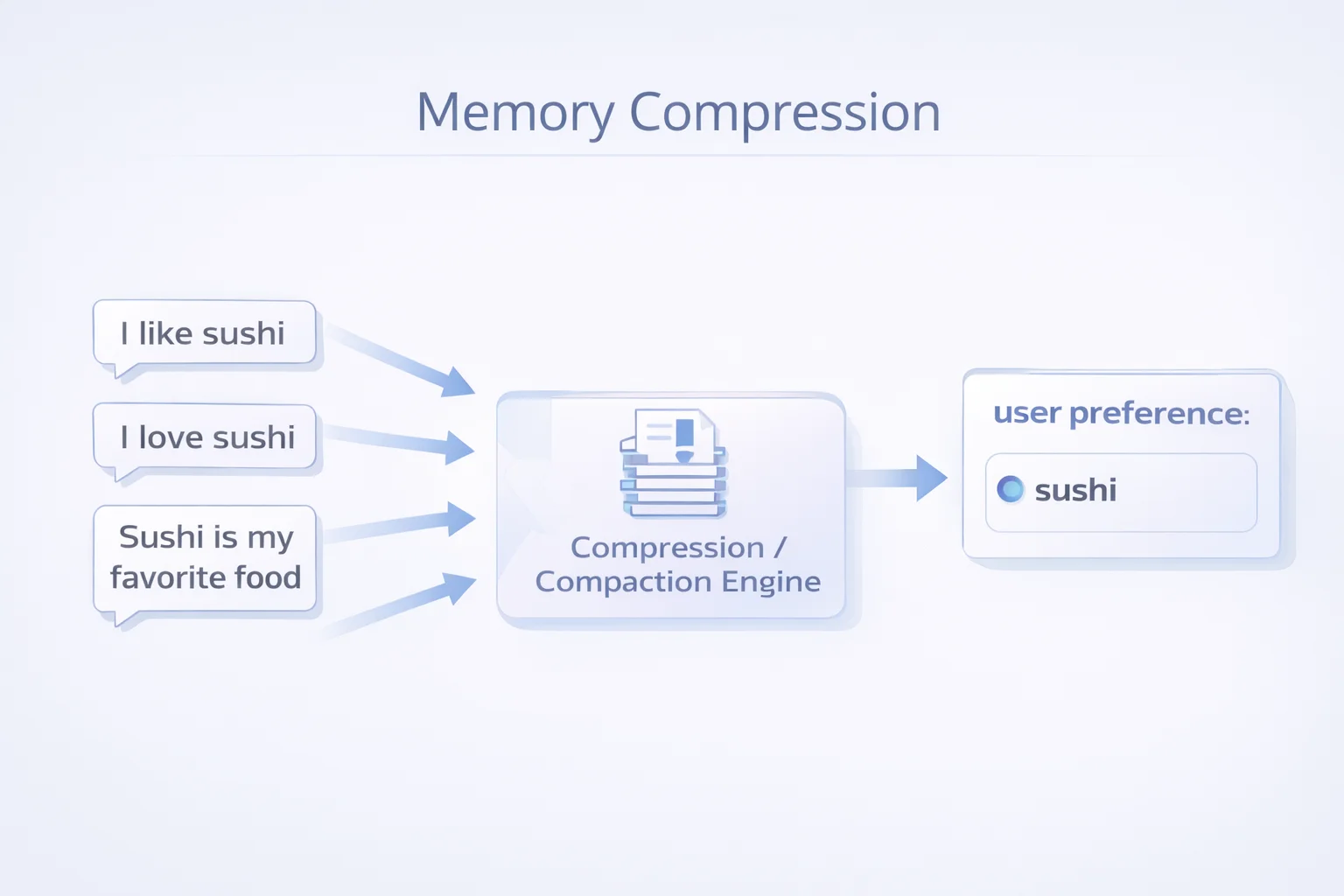
Memory grows without bound. If a system saves every conversation as-is, it will quickly drown in noise.
For example, a user might express a similar preference multiple times: “I like sushi,” “I love eating sushi,” “Sushi is my favorite food.” A naive system stores three or more separate memories, when the only thing of real value is one fact: “The user likes sushi.”
What we need here isn’t simple deduplication, but compressing large volumes of raw interactions into higher-level knowledge representations—a bit like LSM-tree compaction in databases, turning raw logs into higher-level state snapshots. AI memory needs a similar mechanism: from raw interactions to structured knowledge.
Implementing this is far harder than in a database, though.
First is the level of abstraction. Suppose the system observes that the user likes sushi, ramen, and pizza. Should it summarize this as “The user likes food” or “The user likes Japanese cuisine”? Too abstract and you lose information; too specific and you fail to compress. There is still no standard answer for how to automatically choose the right level of abstraction.
Next is choosing when to trigger compression. Periodic compaction can miss urgent updates, while similarity-based triggers can make the system overly sensitive. Just as you don’t tidy your room on a strict timer, nor do you clean up the instant a single item is out of place.
The trickiest part is avoiding information loss. Suppose a user says “I like sushi” and also says “I’m allergic to shellfish.” If the system carelessly compresses that into “The user likes seafood,” it plants a serious safety hazard. Memory compression must be conservative, because once information is lost, it may never be recovered.
Memory Evolution: When Facts Change
Human memory is not static; it updates continuously over time. In 2023 you lived in New York, and in 2024 you moved to Seattle. A good memory system should understand that the New York fact is outdated and Seattle is the current state.
A vector store cannot do this. It simply appends new records while keeping old ones forever. When you query it, the system might return both “The user lives in New York” and “The user lives in Seattle” with no idea which one is right.
From this perspective, a vector store looks more like an append-only log, whereas a real memory system needs a state machine.
Fact updates are a classic case. A user used to say Python was their favorite language, then switched to Rust. The system should update the old memory rather than just appending a new one. In vector space, however, “update” itself is an ambiguous concept.
The time dimension matters just as much. A good memory system should track the validity window of information: “The user lived in New York from 2019–2024, and has lived in Seattle since 2024.” That way, the system can make accurate inferences within a given temporal context.
This naturally leads to distinguishing long-term from short-term memory. “The user likes sushi” is likely a stable long-term preference, while “The user is traveling in Tokyo” is a temporary state. Cognitive science divides this into episodic memory and semantic memory, and AI memory systems need a similar layered structure.
Memory Conflicts: When Information Contradicts
This is the hardest problem—memories will inevitably contradict one another.
Imagine Memory A says “The user is vegetarian,” while Memory B says “The user loves steak.” The system has to decide: which one is true?
Conflicts come from many sources. Maybe the user’s behavior genuinely changed, from vegetarian to omnivore. Maybe the user expressed themselves inconsistently—saying they hate Python today and praising it tomorrow. Or maybe the LLM made a bad inference, mistaking a joke in context for a real preference.
Each conflict-resolution strategy has trade-offs.
Recency priority is the most intuitive: newer information overrides older information. Vegetarian in 2023, started eating meat in 2024, so adopt the 2024 state. But that isn’t always right—the user might just be trying a new diet rather than permanently giving up vegetarianism.
Confidence scoring also helps. Memories stated explicitly by the user can be marked high-confidence, while LLM inferences get low-confidence, with higher-confidence memories winning on conflict. Still, how to quantify confidence itself remains a hard problem.
Source tracking is equally important. Recording whether each memory came from a direct user statement, an LLM inference, or a system preset lets the system trust the user’s words first when conflicts arise—at the cost of extra system complexity.
Another approach is keeping versioned memories: “The user was vegetarian from 2018–2023, and started eating meat after 2023.” That lets the system apply different memory versions across different time contexts, though it increases storage costs and management overhead.
Memory from a Developer’s Perspective
For developers working with AI coding assistants every day, none of these problems are abstract academic exercises.
Within a single project, memory means code style consistency. You tell the assistant “we use camelCase,” “place component files under components/,” and “prefer functional components,” expecting it to remember those rules and follow them automatically in future sessions. If it has to relearn them every time, productivity drops sharply.
Across projects, memory means transferring personal coding habits. You favor certain design patterns, care deeply about type safety, and stick to specific error-handling conventions. If AI can remember those preferences, you get up to speed much faster in new projects.
Compared to manual prompt management, a real memory system has clear advantages. Prompts require manual upkeep, are easy to miss, and have finite length. A memory system updates automatically, retrieves on demand, and can in theory scale indefinitely. More importantly, memory is structured—it can be reasoned over, updated, and reconciled—whereas a prompt is just a flat block of text.
A More Complete Memory Architecture
A mature AI memory system might look like this:
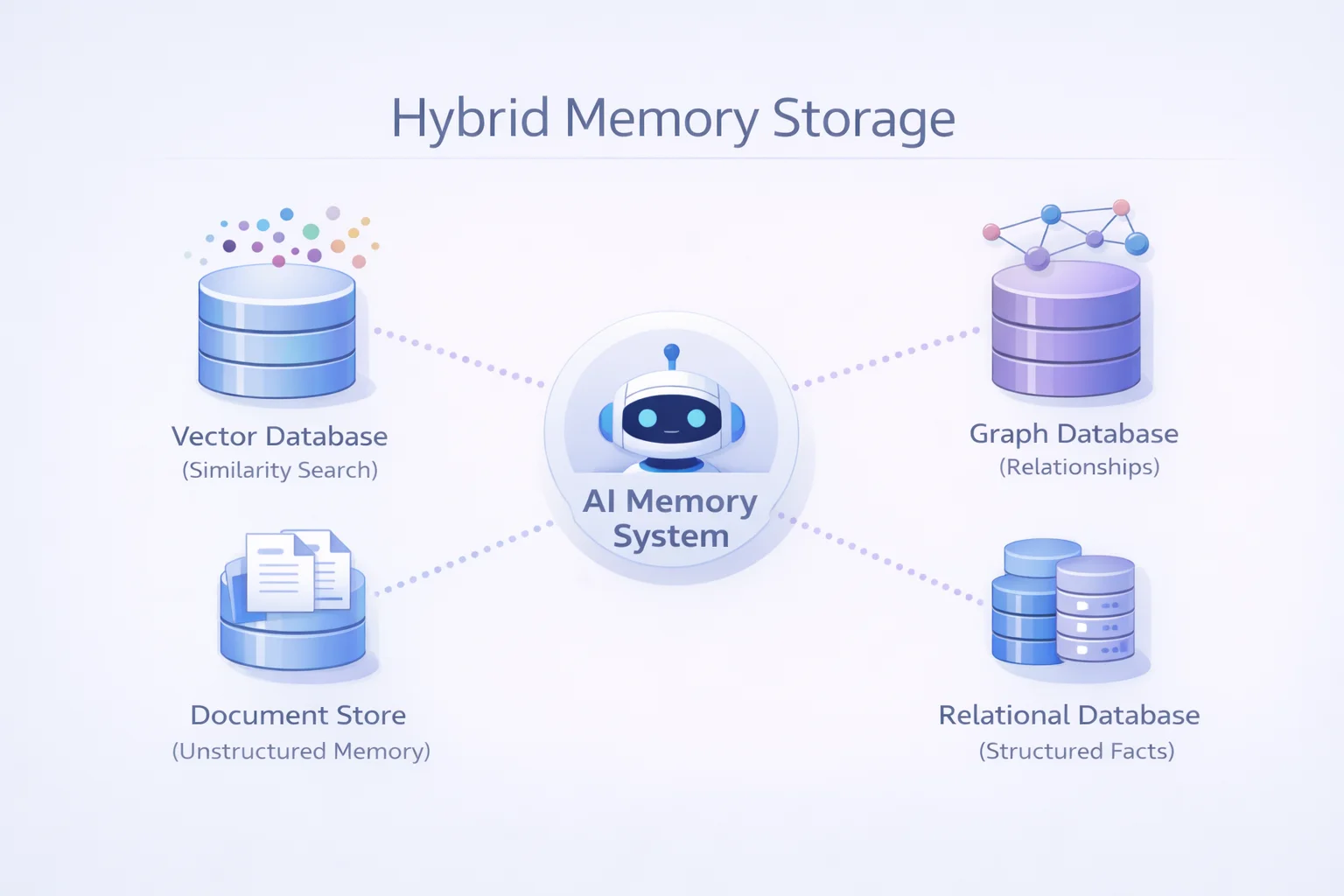
Raw interactions first pass through a memory extraction layer, where an LLM identifies information worth keeping. They then enter structured storage, going through compression, evolution, and conflict resolution pipelines. Finally, a retrieval layer recalls them on demand.
The choice of storage layer is critical too. Vector databases excel at similarity search, but are poor at representing relationships. Graph databases model relationships between entities well. Document stores suit unstructured memories. Relational databases handle structured attributes and constraints effectively. A real memory system will likely require a combination of these stores.
At the workflow level, the system needs to run compaction periodically to compress redundant memories, continuously monitor and update evolving memories, and trigger resolution mechanisms when conflicts appear. This isn’t a one-off batch job—it is a continuously running background process.
Memory Is Fundamentally Knowledge Management
Looking back at these three challenges, they all point to the same insight: AI memory is not a retrieval problem; it is a knowledge management problem.
Vector databases solve similarity search, while a memory system has to solve knowledge representation, evolution, and conflict resolution. It is closer to building a continuously evolving knowledge system than simply maintaining an embedding index.
Projects like Mem0 have already begun exploring memory extraction, scoring, and update mechanisms, recognizing that memory does not equal retrieval. Overall, though, these are still first-generation AI memory systems.
Truly mature AI memory needs to compress experience, update facts, and resolve contradictions. There is really only one core question: how should we represent “memory” itself?
When we have a better answer to that question, AI assistants may finally remember you—not like searching a log for matching entries, but like a friend who remembers what you like, what you have been through, and what you need right now. That will be an entirely different era of interaction.
Copyright
- Author
- XingKaiXin
- Title
- Building AI Memory Systems: From Log Retrieval to Knowledge Evolution
- Published
- 2026年3月16日
Licensed under CC BY-NC-ND 4.0 DEED.