

I can spin up a backend in an afternoon: auth, data layer, API routes—I describe the requirements, and the agent handles all of it. The frontend is where it falls apart. Every page works and looks fine in isolation, yet put them together and it looks like four strangers each built a separate screen.
Most people see this and assume the model has bad taste.
The team behind Moonchild, a design-system-first tool, put it bluntly: Teams without a design system get random UI.
The model generates at the pixel level because it has nothing else to reference. It picks a color here, sets a spacing value there, with nothing tying them together. It doesn’t lack taste—you just didn’t give it a ruler.
How Much Difference Does a System Make
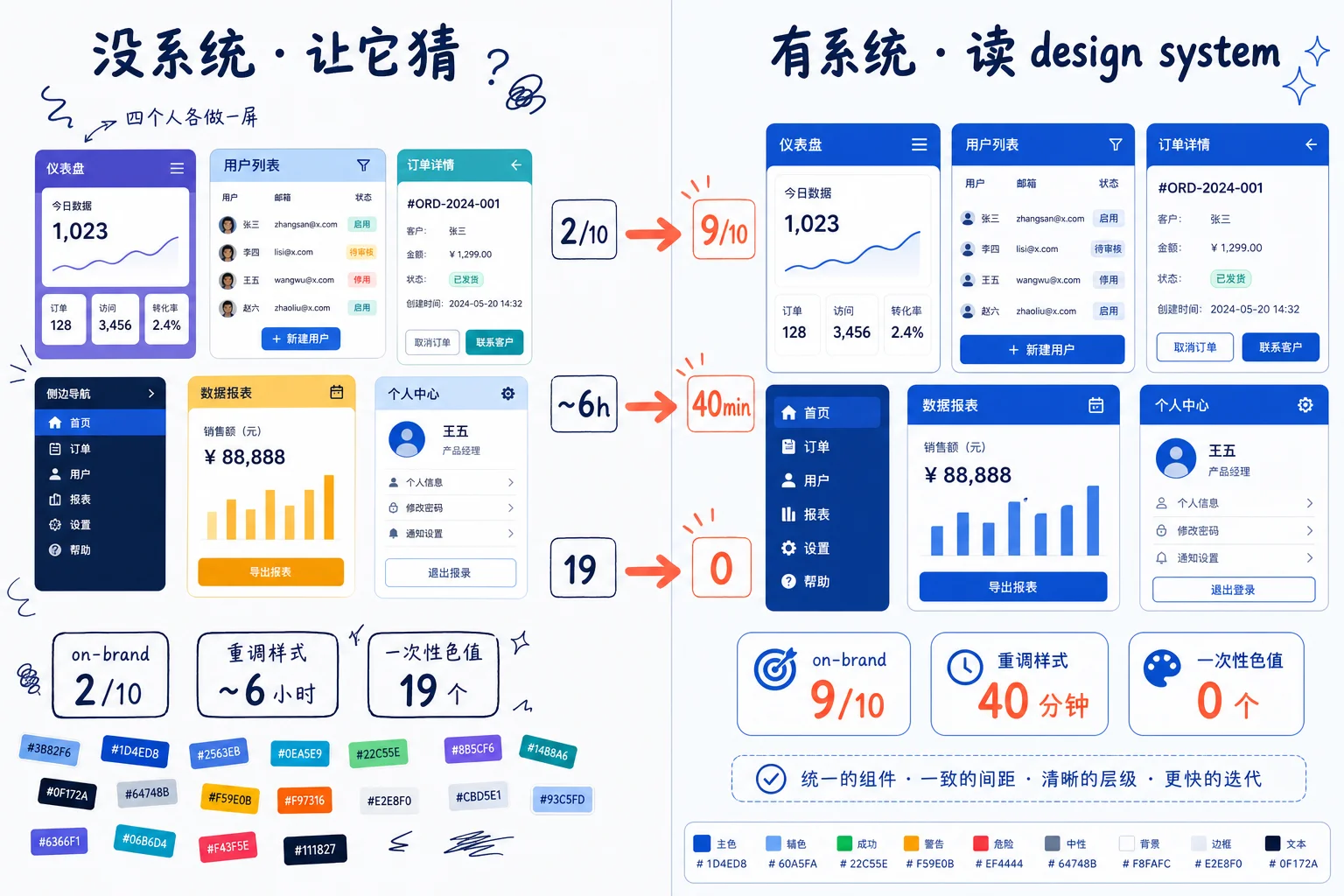
Developer @Mnilax shared a concrete experiment on X: take the same project—an analytics dashboard for monitoring AI apps, ten pages total—and build it twice. First, let Claude Code guess on its own. Second, have it read a design system prepared ahead of time in Moonchild.
The result: pages that came out on-brand on the first try jumped from 2/10 to 9/10. Time spent restyling dropped from roughly 6 hours to 40 minutes. One-off hex values that the agent invented instead of reusing dropped from 19 to 0.
Pay attention to those 19 hex values. Without a system, the agent reinvents the wheel on every single screen—picking one blue it thinks looks fine here, then another almost-identical-but-different blue on the next screen. You think you’re asking it to “build the frontend,” when you’re really asking it to guess your taste over and over. Those 6 hours you spend saying “help me unify the styles” are just you paying the tax on its drift.
How I Actually Do It
I’ve locked this logic into a workflow. Whether I’m building something from scratch or overhauling the frontend styles and interaction logic of an existing project, I always start in Claude Design (at this stage, it’s the tool I trust most).
If it’s an existing project, I have it extract from the current codebase first and redesign a new design system on top of it. If it’s brand new, I give it a concept, drop in an existing design system I already have, or let it design one from scratch.
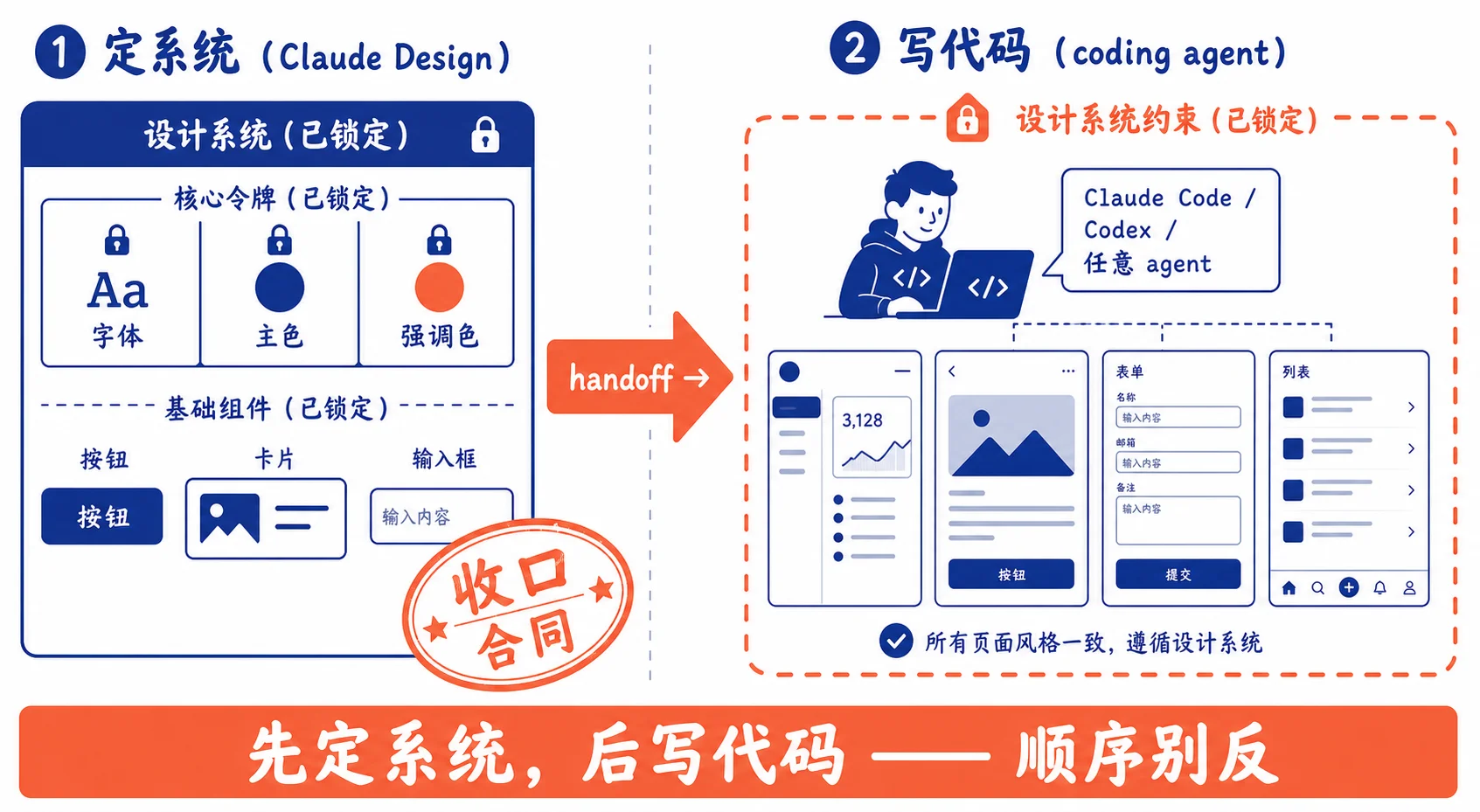
Here is the crucial step: I finalize the entire design system first. Typography, primary colors, accent colors, and the styling for every UI component—all locked down. I evaluate the options in Claude Design and tweak the details until I’m satisfied, closing the loop on the whole system up front.
Only after the system is completely settled do I hand it off to a coding agent to build. Any coding agent works—Claude Code, Codex, whatever you prefer. At that point, they’re writing code under a fixed set of system constraints instead of guessing aesthetics as they go.
What this workflow buys you comes down to one word: predictability.
This Is Really Just a Frontend Spec
I keep coming back to the same point: what constrains an agent isn’t a cleverer prompt, it’s upfront, codified intent. For the backend, I give it acceptance criteria before it starts coding. The frontend is no different—a design system is the frontend spec.
Typography, colors, spacing, components—if you don’t lock these down ahead of time, they turn into ad-hoc style requests you repeat verbally in every conversation. The agent interprets verbal instructions slightly differently each time, which is how you end up with four strangers building four separate screens. Write it down as a system it can reference repeatedly, and style shifts from “re-explained every turn” to “a contract signed once.”
The part most prone to drift—style and interaction—gets closed off early, so the implementation that follows actually holds together.
The Takeaway
Stop expecting prompts to communicate aesthetic taste. Here, a design system is constraint input for the agent, not a style guide sitting around for humans to read.
Finalize the entire system in a dedicated design tool first, then hand it off to a coding agent to implement. Don’t flip the order—system first, code second. Lock the step most likely to drift into a contract upfront, and you get your control back.
Copyright
- Author
- XingKaiXin
- Title
- AI Frontend Looking Like Four Strangers Built It? You Didn't Give It a System
- Published
- 2026年7月6日
Licensed under CC BY-NC-ND 4.0 DEED.