

Last week, someone opened a GitHub issue on one of my tools.
They said a certain export feature froze on large datasets and suspected it wasn’t using streaming. I dug into the code and found the logic—I had asked Claude Code to write it three months ago. The tests passed at the time, I skimmed the diff, and I merged it.
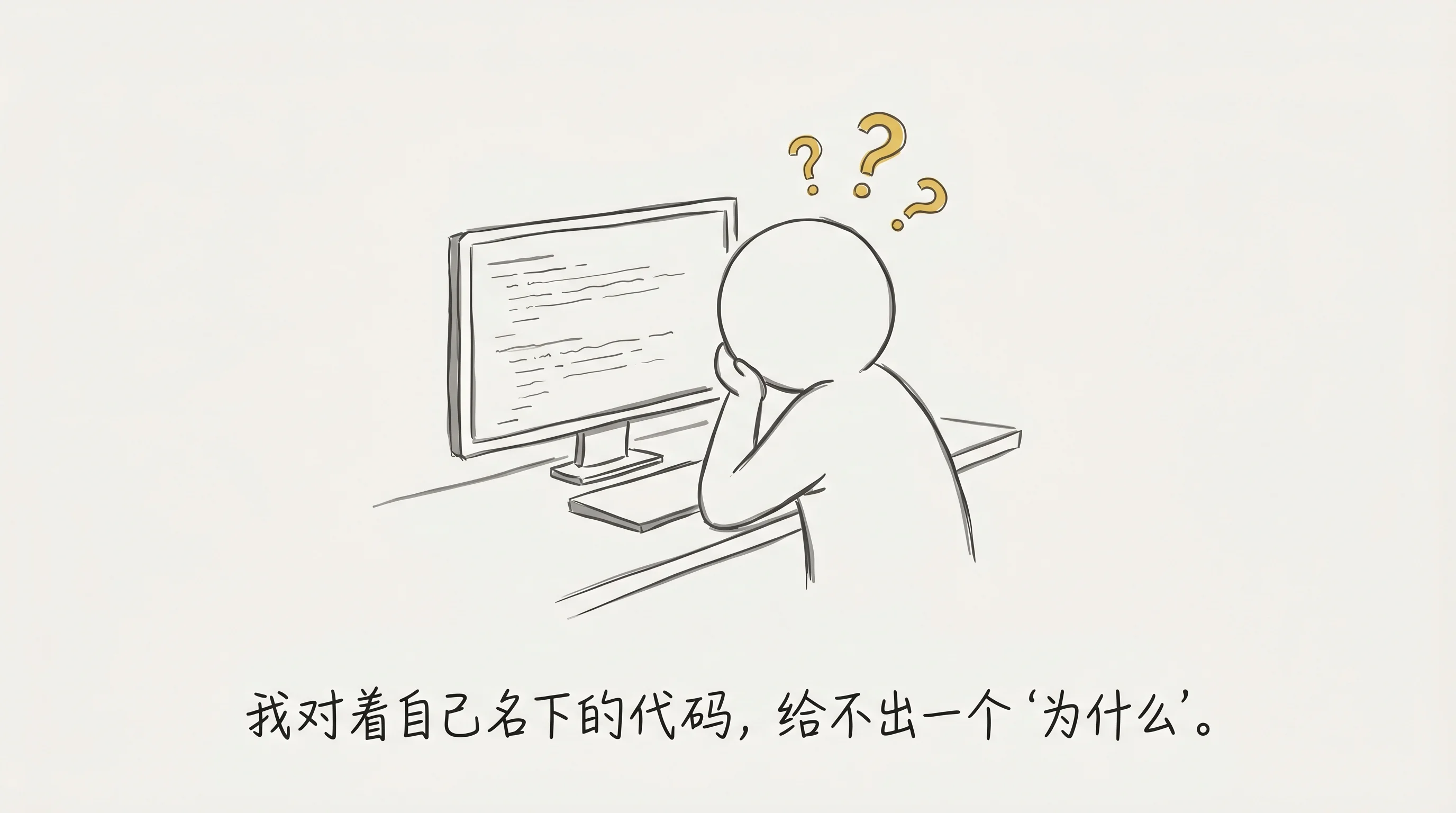
Staring at that code now, I couldn’t explain why it loaded the entire dataset into memory before writing to the file instead of reading and writing in a stream. I couldn’t even remember whether I had mentioned “streaming” as an option when I prompted the AI. My name is on the commit, but if you asked me “why did you choose this approach,” I wouldn’t have an answer.
The person who opened the issue was still waiting for my reply. Looking at code under my own name, I couldn’t give a “why.”
Every Problem Wears the Same Face
When I reviewed that code later, I noticed a deeper problem: it wasn’t that the AI wrote it sloppily. Quite the opposite—it wrote it too “well.”
Clean formatting, consistent naming, solid comments, all the expected branch handling in place. It didn’t look like the result of cutting corners, nor did it look like the author had hesitated anywhere. It had simply picked an approach that passed the current tests with complete confidence and called it a day.
That is the most unsettling trait of AI: its attitude toward every problem is identical—confidence.
Ask it to write an HTTP server in Python, and it gives you a good answer. Ask it to design a locking scheme for a high-concurrency scenario, and it gives you an answer that looks just as good. The tone, structure, and completeness of both answers are nearly identical.
Truth and flaws sit side by side, wearing the exact same face.
When I brought this up with a few backend friends, their reactions were remarkably similar: “Happened to me too.” One had AI write an authentication middleware, only to discover six months later that the token refresh logic had a race condition. Same pattern: the AI’s output showed no cracks during review; the bug hid in the assumptions it never told you about.
That One Second Only Humans Have
Have you ever had a moment where someone asks you a question you’re not quite sure about, and you pause before saying, “I’m not certain about this—I should probably double-check”?
That pause matters. An experienced doctor doesn’t jump straight to a diagnosis when symptoms are atypical; an experienced engineer doesn’t hand out a design the moment they hear vague requirements. It’s not a lack of skill—it’s knowing the boundaries where your judgment becomes unreliable.
There is a word for this: metacognition. The label doesn’t matter much; it simply means having an awareness of the edges of your own judgment—knowing where you’re likely to get things wrong.
AI doesn’t have this.
It won’t hand you a solution and say, “I’m actually not sure about this scenario,” nor will it flag, “The following assumptions might not hold.” There is no trace of hesitation anywhere in its output. It delivers every answer evenly, confidently, and in the exact same voice.
And that uniform confidence is precisely where the biggest risk lies: you lose your grip on judgment.
When you wrote code yourself, uncertainty made you hesitate—you’d check the docs, or ask a colleague. That hesitation itself was a quality filter. Slow, yes, but it caught plenty of bugs. Now that filter is skipped. The AI doesn’t hesitate; it hands you an answer right away. If you don’t hesitate either—because the answer looks clean on the surface—the risk is amplified from both ends: no self-doubt on the generating side, and none on the receiving side.
Someone once left a comment I thought nailed it: “That gut feeling when reading AI code—‘something feels off, though I can’t say why’—isn’t code review skill. It’s your body sounding the alarm for your metacognition.”
From “I Wrote It” to “I Let It Through”
AI lacking metacognition isn’t scary on its own. It’s just a property of the tool; once you know it, you account for it.
What’s actually scary is that over time, your own metacognition starts to erode.
Committing code used to carry an implicit weight—your name was attached to it, meaning if something broke, you could stand up and say: I chose this, because of X. Even if that decision took three seconds, it was yours.
What about now? Your name is on the commit, but who made the “decision”?
A decision is “I weighed A and B, and chose A.” Letting it through is “AI chose A, and I didn’t spot anything obviously wrong.” The two look identical in git log, yet the meaning of responsibility is completely different.
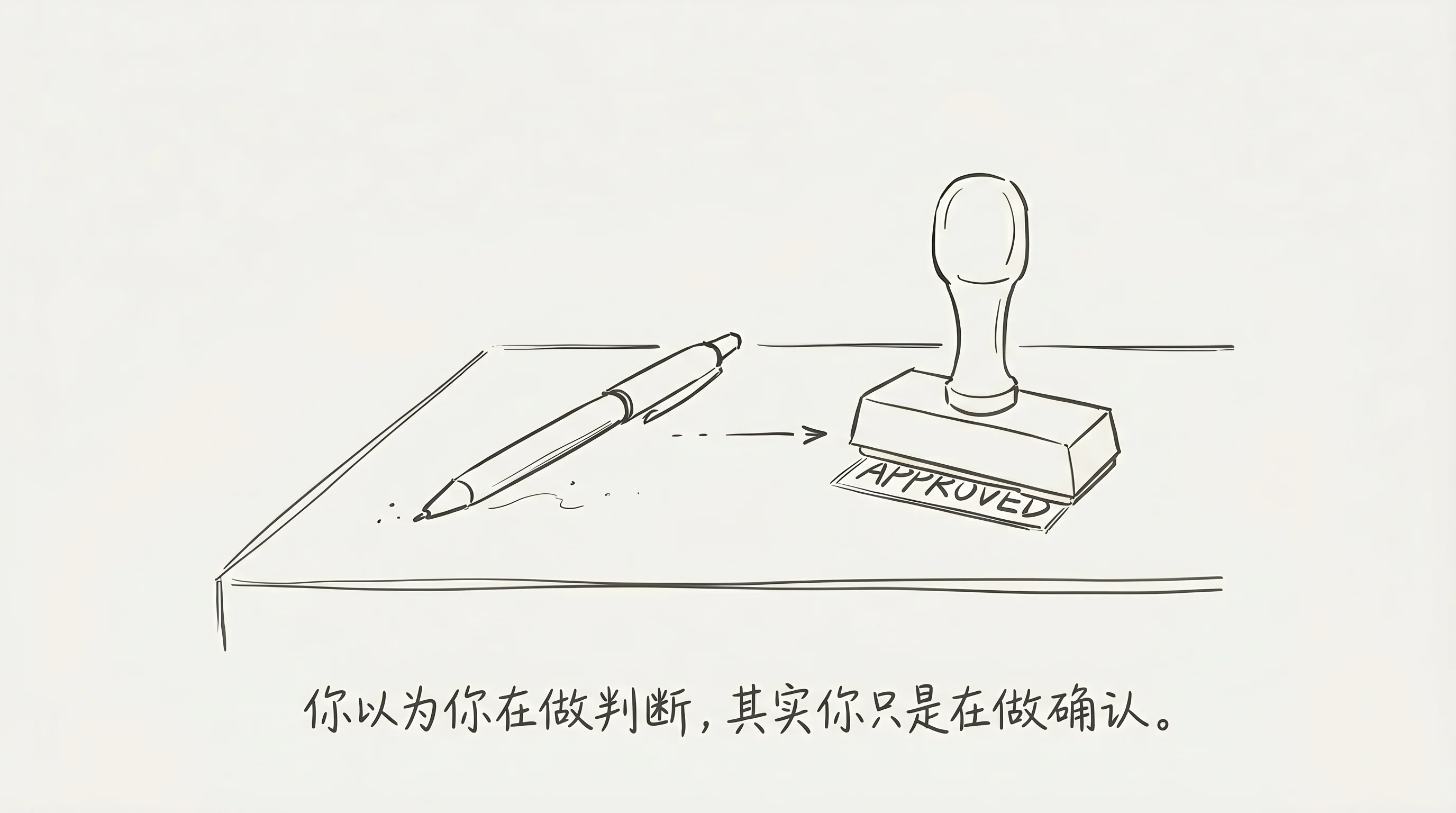
Your name is still on the commit, but your relationship to the code has shifted—from “I wrote it” to “I let it through.” Until one day you realize there are thousands of lines of code under your name, and for most of them all you have left is a vague impression: “Seemed fine at the time.”
That instinct of “every line is mine” is trained through years of writing code by hand—every line you typed and every pitfall you hit reinforced the awareness that if things go south, it’s on you. Now that training loop is being bypassed, and the instinct is fading. Like a muscle, what you don’t use atrophies.
The Distance Between “Not Vetoing” and “Deciding”
When someone asks “why is this code written this way”—whether in a GitHub issue, a user DM, or when an alert wakes you up at midnight to check the logs—there used to be an answer: I evaluated A and B; A was faster, B was safer, and given the context I picked B. Right or wrong, there was at least a traceable chain of reasoning.
And now? I asked around among developers I know, and the most common answer was: “That’s just how the AI generated it.”
It rolls off the tongue easily. But think about what it actually means: the answer has become “nobody chose it; it just came out that way.” The entire decision process was skipped. You didn’t even weigh the trade-offs—you used whatever the AI output. That doesn’t even qualify as a “bad judgment call,” since at least a judgment call can be reviewed and improved.
The distance between “not vetoing” and “making a decision” is the exact width of the responsibility vacuum.
Security scenarios are even more unsettling. You ask AI to write an endpoint that accepts user input. It gives you a working version, the tests pass, and you merge it. Three months later, someone discovers the endpoint lacks input validation, and a crafted request can pull data it has no business accessing.
After an incident, “how did our tests miss this” still has a technical answer. The far more awkward question is “who decided to design it this way.” You check the commit history, and your name is right there. Yet you know you never “decided” anything. You simply didn’t veto the AI’s output.
This vacuum is sitting quietly in countless codebases right now, unnoticed. Test reports don’t show it, code reviews don’t flag it, and no metric leaves a trace of it. It only becomes visible after something breaks, in the most embarrassing way possible.
Staying Alert in the Gray Areas
There is no methodology that can save you here.
Metacognition comes from experience, and experience comes from time and trial and error. You can’t gain the ability to “know what you don’t know” by reading an article. Likewise, the “imperfect but right” call a good engineer makes in a given moment—trading a bit of performance for readability, or cutting a clever abstraction for simplicity—isn’t taught by a rulebook. It’s intuition honed through years of practice.
At bottom, both abilities are the same thing: staying alert in the gray areas.
Back to that GitHub issue.
I eventually gave the user an honest reply: confirmed the bug, explained that the original implementation assumed small datasets, and promised to switch it to streaming.
After writing that reply, though, I added a habit for myself. Before merging any AI-generated code, I ask myself one question:
“If this code breaks tomorrow and someone asks me why it was written this way, can I give them an answer?”
Just one question.
If I can answer it, I merge. If I can’t, I step back and read it again.
As for how long I’ll stick to this habit—honestly, I’m not sure. When you’re rushing to ship, “merge first, deal with it later” is almost a reflex.
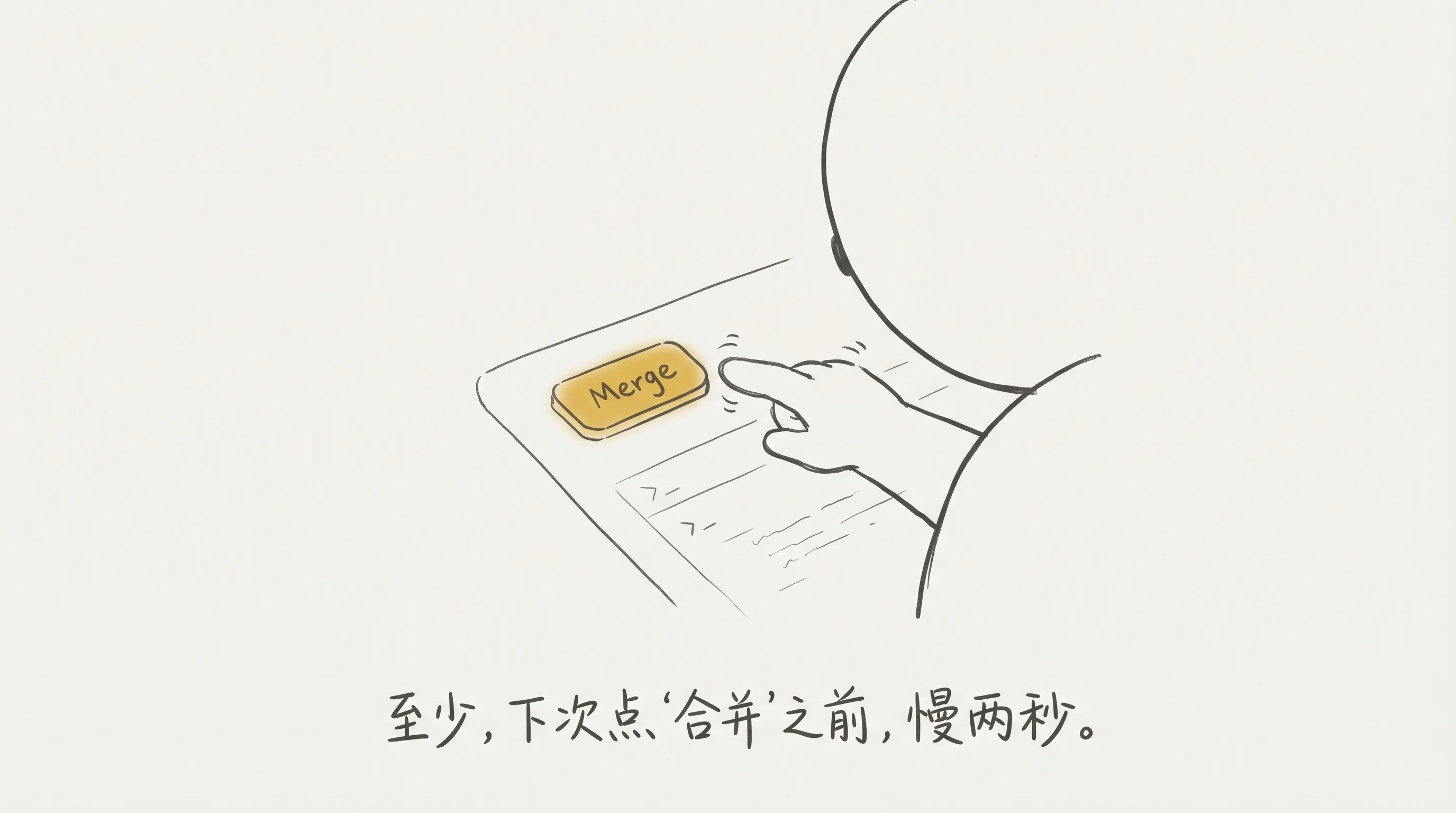
But for now, every time I’m about to click merge, that issue page flashes through my mind—a stranger waiting for me to explain code I couldn’t even account for myself.
That’s a feeling I don’t want to have a second time.
At the very least, next time you click “Merge,” pause for two seconds.
Copyright
- Author
- XingKaiXin
- Title
- Would You Put Your Name on AI-Written Code?
- Published
- 2026年4月27日
Licensed under CC BY-NC-ND 4.0 DEED.